
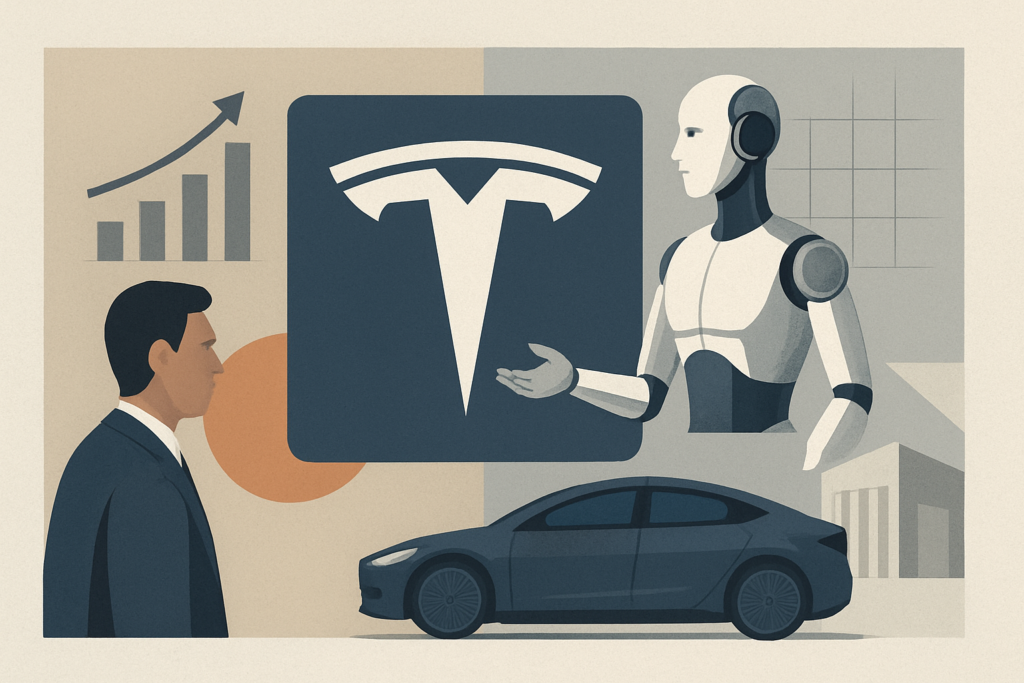
Tesla will report second-quarter financial results after the market closes on Wednesday, with investors weighing a recent rebound in vehicle deliveries against a year-to-date slide in the stock and chief executive Elon Musk’s intensified focus on robotics and autonomy.
What Wall Street is expecting
Analysts polled by LSEG expect Tesla to post earnings per share of $0.51 and revenue of about $25.71 billion, reflecting roughly 14% revenue growth versus a year earlier. The company’s share price has fallen about 16% so far this year, trailing the broader Nasdaq, which is up around 11%.
Tesla’s market performance has moved in step with volatility at SpaceX, which underwent a record market debut in June and has since lost nearly 40% of its peak value. The stock decline has come despite signs of recovery in the automaker’s core business: Tesla reported a roughly 25% increase in vehicle deliveries year over year for the quarter, topping 480,000 units.
Deliveries, pricing moves and market pressures
After two consecutive years of declining deliveries, Tesla has begun to regain momentum. In the quarter it introduced lower-cost variants of the Model 3 and Model Y and expanded availability of its premium driver‑assist product—marketed in the U.S. as Full Self‑Driving (Supervised)—into parts of Europe.
Several external factors have helped. Higher gasoline prices tied to the conflict in the Middle East bolstered demand for EVs in the first half of the year, and European customers have been increasingly responsive to electrified models. At the same time, competition from Chinese automakers such as BYD, Nio and Xiaomi has intensified globally, undercutting Tesla with competitively priced, feature-rich electric vehicles. Political backlash against Musk’s rhetoric has also influenced some buyers.
From cars to robots: Musk’s strategic pivot
Musk has been steering the company’s narrative away from pure vehicle sales and toward an ambition to build autonomous ride‑hailing services and humanoid robots. Tesla is ramping production of what it calls the Cybercab for driverless operations and has retooled older lines at its Fremont factory to start making Optimus humanoid robots.
On the company’s previous earnings call, Musk said he expects Optimus to outstrip all other Tesla products in importance. He has set aggressive goals for autonomous services in the past—such as a 2019 projection of 1 million robotaxis by 2020—and more recently predicted that ride‑hailing services would cover a substantial portion of the U.S. population within a few years. Those timelines have slipped, and company watchers note a pattern of ambitious targets that remain unmet.
Competition and credibility challenges
In autonomous ride‑hailing, Tesla trails Alphabet’s Waymo in the U.S. and Baidu’s Apollo Go in China. The humanoid robotics field is crowded as well, with players including Unitree, Boston Dynamics, Agility Robotics, Apptronik and London‑based Humanoid developing competing designs and use cases.
Analysts and industry experts say Tesla’s public commitments to autonomous mobility and physical AI have been bold, and the company has not always delivered on its most sweeping predictions. That history is part of what investors will scrutinize as Tesla reports earnings and provides commentary on its longer‑term product roadmap.
Key items investors will watch on the call
Beyond revenue and margins, the investor call is expected to focus on how Musk plans to balance near‑term vehicle growth with heavy investment in robotics and autonomy. Shareholders will want updates on production progress for Cybercab and Optimus, any timing changes for commercial deployment of driverless services, and details on regulatory rollouts such as the European availability of FSD (Supervised).
Another topic of interest is the relationship between Tesla and SpaceX. The companies are collaborating on Terafab, a large chip manufacturing project in Texas that they plan to run with Intel—an initiative that could affect Tesla’s autonomy ambitions if it yields more customized silicon for AI workloads.
Tesla enters the report with mixed signals: solid delivery growth after a difficult stretch, fresh pricing and product moves, and a strategic pivot toward high‑risk, high‑reward technologies. The earnings release and conference call will be watched closely for concrete milestones and managerial clarity on how the company intends to deliver on its robotics and autonomous visions while sustaining its automotive recovery.
Source: CNBC