
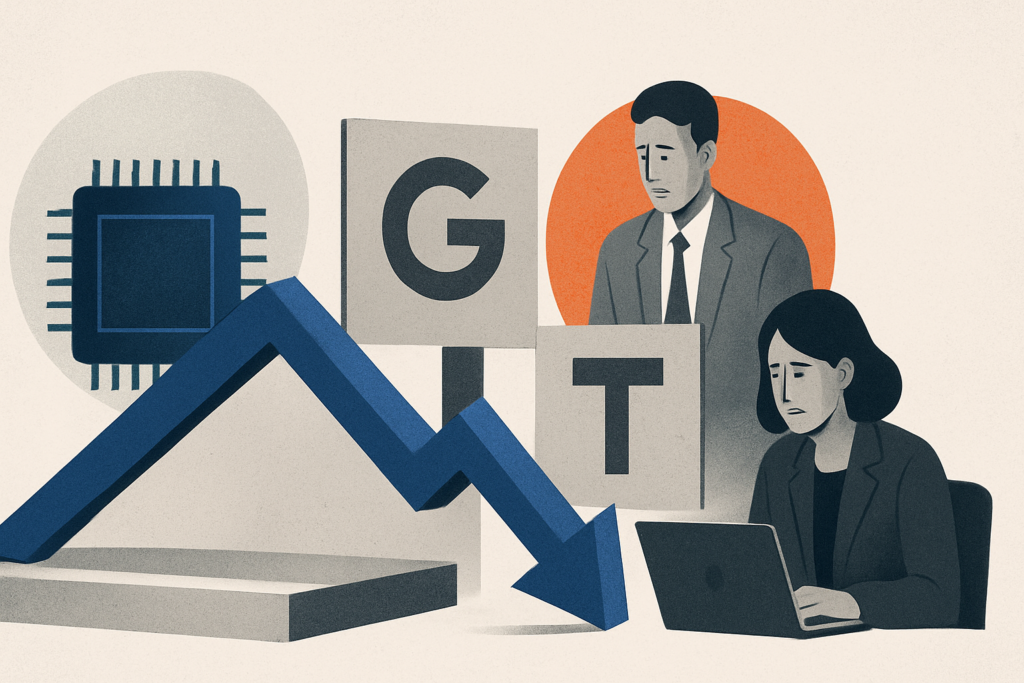
Shares of Alphabet (Google’s parent) and Tesla plunged after both companies reported negative free cash flow and gave updated plans for large capital investments — much of it tied to artificial intelligence and related infrastructure. The results and guidance prompted steep after‑market moves, as investors questioned when the huge spending will translate into profits.
Alphabet and Tesla report negative cash flow and trigger market sell-off
Alphabet’s stock fell nearly 7% on Thursday after the company disclosed a second quarter free cash flow of negative $5.9bn, the first time the cash metric has turned negative since it became a public company in 2004. The company posted combined quarterly revenue of $119.8bn, up 23% year‑on‑year, but heavy capital spending pushed leftover cash into negative territory.
Tesla’s shares fell 14.5% after the electric‑vehicle maker revealed negative free cash flow of $1.1bn for the second quarter. Both companies also announced significantly larger capital plans: Alphabet now expects to spend as much as $205bn this year, up $15bn from an estimate three months earlier, while Tesla said it expects to spend up to $25bn this year.
Where the spending is going: servers, data centres and unspecified projects
Alphabet told analysts that its growing capital expenditures were essentially all related to AI. The company said it spent $45bn in the second quarter, with roughly 60% of that cost going to servers and 40% to data centres. Alphabet’s capital spending had been $36bn in the first quarter of the year.
Alphabet’s chief financial officer Anat Ashkanazi said the negative free cash flow was driven by these rising capital costs and that “the demand still outpaces that investment.” CEO Sundar Pichai described the shift to AI tools and capabilities as feeling like the “early innings” and characterised the company’s return plans as “disciplined.”
Tesla provided fewer line‑item details about its planned spend, describing the company as being in “a big investment cycle.” CFO Vaibhav Taneja said the company expects spending to rise further over the next three years but did not specify how the $25bn will be allocated.
Why it matters
The immediate market reaction shows investors are scrutinising the trade‑off between rapid AI infrastructure build‑outs and short‑term cash generation. For Alphabet, the cash outflow is notable because it comes despite strong revenue growth; for Tesla, the negative cash flow marks the company’s first such quarterly shortfall in two years.
Large, AI‑linked capital programmes affect multiple stakeholders: investors face a longer wait for potential financial returns, suppliers of AI hardware and data‑centre components may see stronger demand, and companies that rely on cloud or developer economics could experience changing pricing and capacity dynamics as big tech firms expand infrastructure.
Investor scepticism and company messaging
Market commentators highlighted the gap between spending and investor expectations. Russ Mould, an investment director at AJ Bell, said there remains “a healthy degree of scepticism about the ability of these investments to generate a commensurate level of return.” Rachel Winter of Killik & Co said some investors were surprised by the scale of Alphabet’s spending, and that the share price drop suggested concern about those levels.
Alphabet’s executives argued the investments are responses to outsized demand for AI capacity and that opportunities to invest remain attractive. Sundar Pichai framed the work as necessary to translate frontier AI capabilities into user experiences, while Anat Ashkanazi emphasised continued investment so long as attractive opportunities exist.
What to watch next
Key questions remain unresolved in the companies’ disclosures. For Alphabet: how and when will the expanded server and data‑centre footprint begin to generate net cash returns, and how will efficiency or product monetisation offset continuing capex? For Tesla: the breakdown of the planned $25bn — whether it is for factories, energy, AI systems, or other projects — is unspecified.
Investors will also watch subsequent quarterly results for signs that heavy capex is translating into higher margins, new revenue lines or improved unit economics. Market reaction may hinge on management commentary about timelines for monetising AI investments and on any incremental detail about how the capital is being deployed.
Alphabet and Tesla have signalled much larger AI‑era capital programmes; the immediate effect was steeper share price declines as investors weighed the cost of building future AI capacity against the uncertain timing of returns.
Source: BBC