
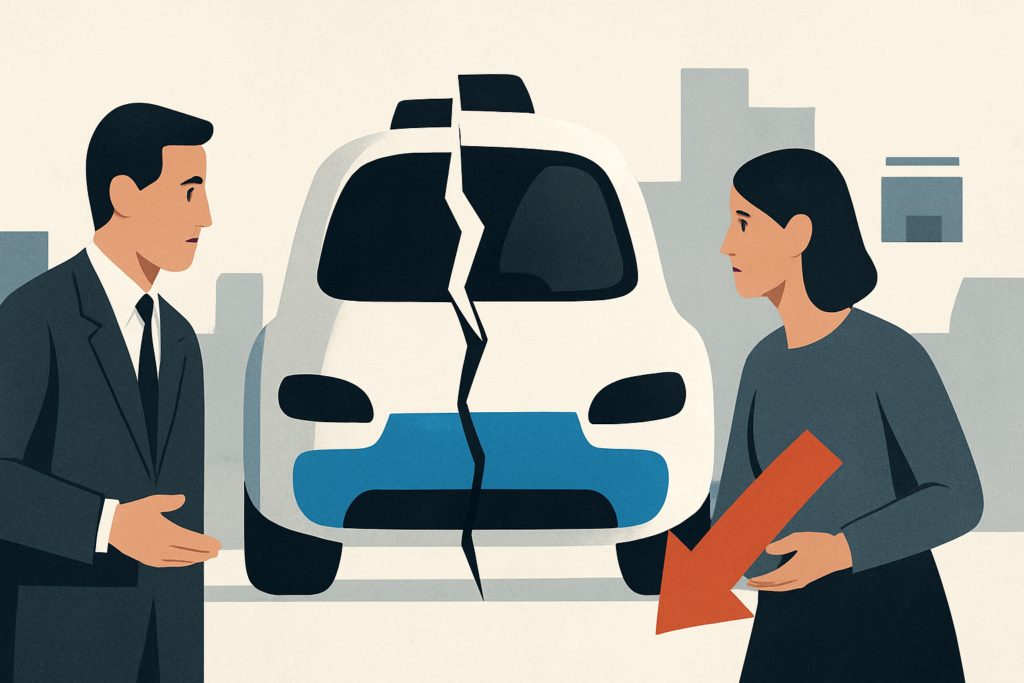
The Financial Times reported on 24 July 2026 that Waymo is exploring a split from Uber amid deepening tensions over their robotaxi partnership. If the talks progress, the change could alter commercial partnerships, valuations and how autonomous-vehicle fleets are run — affecting operators, cities and developers tied to robotaxi deployment.
FT reports Waymo is exploring separation from Uber
The Financial Times said Waymo, Alphabet’s autonomous-vehicle unit, is exploring a split from Uber in relation to their robotaxi arrangements. The report described tensions over the business as having deepened and framed a potential separation as significant for the robotaxi market. The story did not publish detailed terms or confirm negotiations were finalised; it presented the development as an ongoing exploration reported by FT on 24 July 2026.
How a separation would change robotaxi commercial and operational arrangements
The FT coverage does not specify precise mechanics of a split, but the central consequence is straightforward: disentangling Waymo’s technology and operations from Uber’s marketplace and fleet management would force a reallocation of roles and assets. That could involve changes to who controls vehicle fleets, who aggregates rider demand, and how operational data is shared across partners.
Practically, a split could shift responsibilities along these lines: one company retaining core autonomy software and sensing systems, the other keeping customer-facing booking, pricing and marketplace infrastructure; alternatively, each could operate independently in different cities. The report implies that such choices would affect fleet economics — who pays for vehicles and maintenance, who sets fares, and how revenue is split between technology provider and ride platform.
Why it matters
The FT framed the potential split as capable of reshaping partnerships, valuations and operational models in robotaxi deployment. For operators and investors, a formal separation would clarify where value accrues: either in autonomous driving stacks, marketplace scale, or integrated services. For cities and regulators, changes to which entity holds operational control could alter regulatory exposure — from vehicle-level safety oversight to compliance with local transport rules and liability frameworks.
Developers and suppliers also stand to be affected. If Waymo narrows partnerships and operates more directly, third-party integrators and fleet partners could lose access to shared platforms or data. Conversely, a move away from a tightly coupled relationship with a major ride-hailing platform could open commercial opportunities for alternate fleet operators or municipal deployments that negotiate directly with fleet technology providers.
Commercial and regulatory context and implications
The FT report situates this potential split within mounting tensions over the robotaxi business rather than detailing a single trigger. That suggests a wider set of trade-offs: integrated partnerships can speed deployment by combining software, vehicle assets and demand, but they also concentrate bargaining power and operational risk. Separations reverse that concentration — potentially reducing single-point operational risk but increasing coordination costs between technology providers and marketplace operators.
Regulatory consequences depend on which functions move where. If Waymo retains technical control over driving systems while Uber retains marketplace functions, regulators may need to clarify liability and safety oversight across separate corporate entities. If control centralises with one firm, that firm would carry more direct regulatory exposure. The FT piece highlights that these are material commercial questions that investors and city governments watch closely when judging the viability of robotaxi rollouts.
What to watch next
Public confirmation: Whether Waymo or Uber issue formal statements or regulatory filings clarifying negotiations or corporate changes.
Deal terms: If talks advance, the structure — asset transfers, data-sharing agreements, revenue splits and liabilities — will determine operational outcomes and investor valuations.
Regulatory responses: How local transport authorities and safety regulators interpret a separation in terms of oversight, permitting and liability frameworks.
Market responses: Whether other AV developers or ride platforms revise partnership strategies in response — for example, seeking tighter integration or diversified distribution channels.
At present the development is a report of exploratory talks rather than a completed transaction; its significance lies in how it exposes the tensions inherent in combining autonomous driving technology with large-scale ride-hailing marketplaces.
Source: Financial Times