
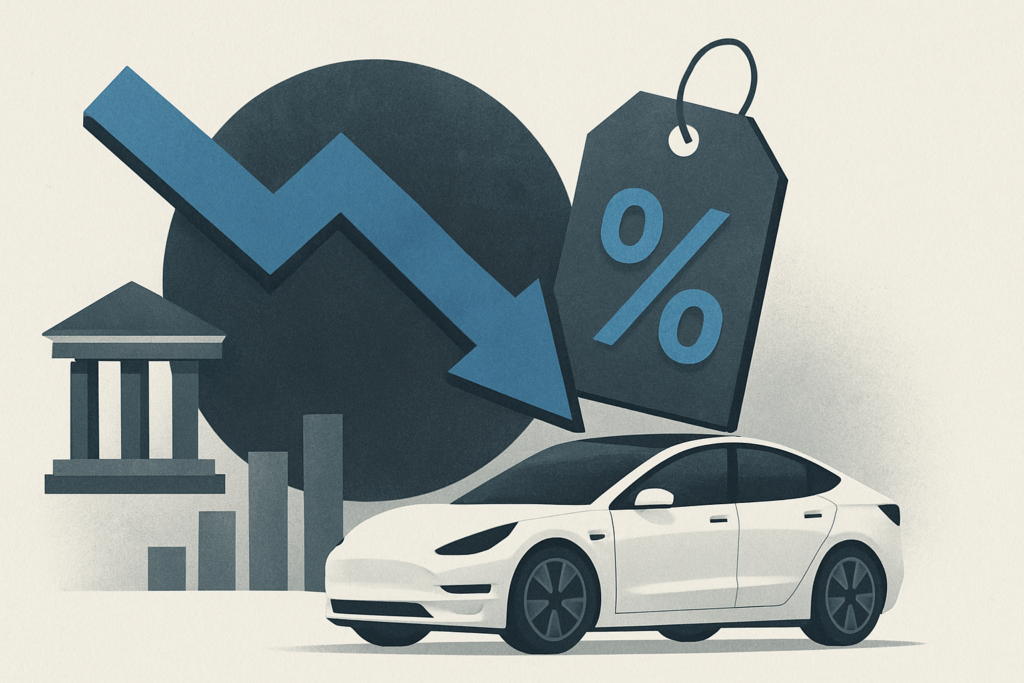
The Financial Times reported that Tesla’s profits plunged as discounts on its electric-vehicle models weighed on results. The FT headline signals a shift in the company’s recent financial performance tied to pricing actions for its vehicles, but full details remain behind the publisher’s paywall.
What the FT headline conveyed
The FT’s coverage, summarized in its headline, links a fall in Tesla’s profits to the company’s decision to discount certain EV models. The framing suggests that pricing moves designed to stimulate demand or clear inventory had a material effect on the firm’s bottom line. Beyond that direct connection, the article itself is not available in full in the supplied material, so particulars such as the scale of the profit decline, which models were discounted, and Tesla’s commentary are not included here.
How discounts typically affect automaker results
Price reductions can be a blunt tool to boost unit sales quickly, but they also compress gross margins. For automakers, a reduction in the average selling price can reduce per-vehicle profitability even if volume rises. Fixed manufacturing and operating costs do not fall in step with discounts, so the company’s overall profit can decline if the incremental revenue from greater volume is insufficient to offset lower prices.
Discounting can also change the mix of sales between higher- and lower-margin products, affect residual values for used vehicles, and alter customer expectations about future pricing. For manufacturers that have previously relied on premium positioning or tight control of supply as part of their margin strategy, sustained discounts may be particularly erosive to profitability.
Potential strategic reasons for Tesla to discount
Companies typically choose to reduce prices for several strategic reasons: to accelerate delivery and convert reservations into sales, to respond to weakening demand in a particular market, to clear inventory ahead of new model introductions, or to match competitive pricing moves. Discounting can also be used tactically in specific regions or for particular configurations where demand has softened.
While the FT headline ties Tesla’s profit decline to discounts, the broader strategic context — whether the price cuts were temporary, targeted, or indicative of a longer-term pricing shift — is not available in the supplied material. That distinction is important for assessing how management might respond and what the change means for future results.
Implications for Tesla and the EV market
If discounts are prompting meaningful profit compression at Tesla, the development could have several implications. It could signal increased price competition in the broader EV market as rivals vie for market share. It might also suggest cyclical softness in consumer demand or shifts in incentives and subsidies that affect buyer behaviour.
For Tesla specifically, pressure on profits could lead management to reconsider production schedules, cost reduction initiatives, or adjustments to product features and options that influence net selling prices. It could also prompt closer scrutiny from analysts and investors on margin drivers rather than sales growth alone.
Investor and market reaction considerations
News of a profit decline tied to discounts typically focuses investor attention on the sustainability of earnings and the company’s margin structure. Market participants will often look for follow-up information in quarterly earnings reports, regulatory filings, or management commentary that explains the causes and expected duration of any pricing actions.
Absent detailed figures, investors and analysts will likely want to know whether discounts were a one-off tactical move or part of a broader strategic repositioning. They will also monitor indicators such as delivery volumes, order backlogs, and any comments on manufacturing efficiency and cost control.
Limitations and next steps
This article is based solely on the Financial Times headline supplied in source material and does not include the FT’s full reporting or Tesla’s official statements. For a complete assessment, readers should consult the full FT article, Tesla’s public filings and earnings releases, and company commentary. Those primary sources will provide the concrete figures and management perspective needed to evaluate the causes and likely persistence of the reported profit decline.
In the near term, stakeholders can expect follow-up reporting and financial disclosures to clarify the scale of the profit impact, the duration of any discounts, and whether Tesla intends to adjust pricing or operational strategies in response.
As the EV sector continues to evolve, pricing dynamics will remain a central factor shaping profitability and competitive positioning across manufacturers.
Source: Financial Times