
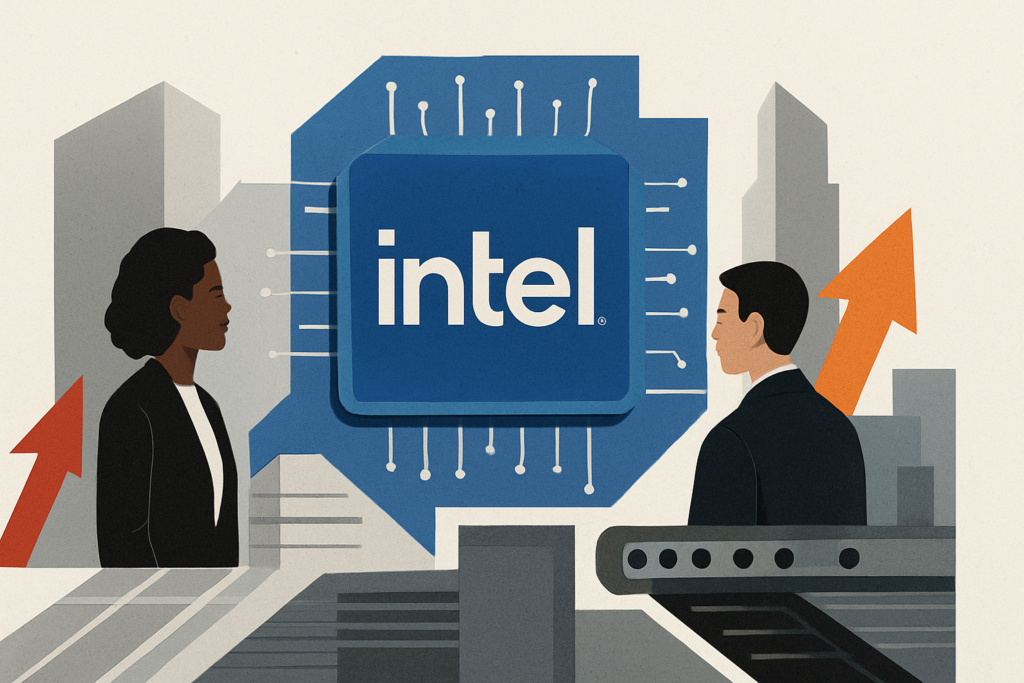
Intel this week reported its fastest growth in 15 years, a result the company credited to stronger-than-expected demand from data centres and AI-related workloads. The market reaction — a sharp rise in the share price — reflected investor relief that one of the industry’s largest chipmakers is capitalising on the AI hardware cycle. Beyond the headline, the results illuminate which product lines are gaining traction, how supply chains and manufacturing are responding, and what enterprise buyers and competitors should expect next.
Which segments most likely fuelled the surge
Intel’s recent growth is concentrated where most semiconductor value is being captured today: server CPUs and AI-targeted accelerators, plus related systems and services. Server-class processors remain the backbone of data-centre revenue as cloud providers refresh fleets to support larger models and higher inference throughput. At the same time, purpose-built AI accelerators and silicon optimised for training and inference workloads are in increasing demand from hyperscalers and specialised cloud customers.
Intel’s manufacturing and foundry-related businesses also appear to be benefiting. The company has been investing to expand capacity and to offer third-party foundry services; any meaningful lift in its foundry pipeline—whether from internal product ramp or external customers—would be a material contributor to overall growth. Taken together, stronger server CPU sales, increased uptake of AI accelerators, and an improving foundry picture form the most plausible explanation for the company’s recent performance.
Implications for supply chains and manufacturing
Heightened demand for AI and data-centre silicon amplifies pressure across the chip supply chain. Wafer fab capacity, advanced packaging, substrate supply and test-and-assembly services all must scale to meet customers’ orders. For Intel, which pursues both integrated device manufacturing and third-party foundry work, that means juggling internal capacity allocation while expanding external customer engagements.
Key bottlenecks tend to shift as demand moves from CPUs to accelerators and specialised chips. Advanced nodes and heterogeneous packaging become more critical for accelerator performance per watt, increasing reliance on specialist materials and advanced testing. If demand continues to accelerate, enterprises should expect longer lead times for customised server configurations and for new accelerator types unless suppliers expand capacity quickly.
What this means for competitors and enterprise buyers
Intel’s momentum forces competitors to re-evaluate product roadmaps and pricing strategies. For incumbents and challengers alike, the market is now about not just raw performance but system-level integration, software stacks and total-cost-of-ownership for AI workloads. Competitors that offer mature software ecosystems and robust developer tooling will be better positioned to take share, even if raw silicon performance is comparable.
For enterprise IT and procurement teams, the immediate takeaway is to revisit refresh cycles and procurement lead times. Organisations planning sizeable AI deployments should engage earlier with vendors to secure capacity, negotiate tariffs and SLAs that reflect the current supply environment, and evaluate heterogeneous architectures that combine CPUs, GPUs and domain-specific accelerators. Multi-vendor strategies may reduce exposure to single-supplier lead-time risk and can improve bargaining leverage.
Near-term risks and what to watch
Several risks temper the positive headline. First, semiconductor markets are cyclical; a surge tied to AI hype could normalise if model architectures or deployment patterns shift. Second, supply-chain scaling is non-trivial—delays in packaging, testing or substrate availability can blunt revenue upside even if chip demand remains high. Third, competitive moves from other chip vendors and foundries—both on pricing and on accelerated product roadmaps—could compress margins.
Observers should watch three indicators closely: capacity announcements and utilisation rates at fabs and OSATs; product mix disclosures from vendors that reveal what share of revenue is coming from AI accelerators versus general-purpose CPUs; and enterprise procurement patterns from major cloud providers, which often presage broader market demand. Together these signals will indicate whether Intel’s growth is a durable market-share gain or a near-term cyclical uptick.
Intel’s strongest growth in 15 years underscores how AI is reshaping demand dynamics across the semiconductor industry. For engineers, procurement teams and cloud architects, the immediate challenge is aligning system design and buying timelines with a supply chain that is evolving rapidly to support next-generation AI workloads.
Source: Financial Times