
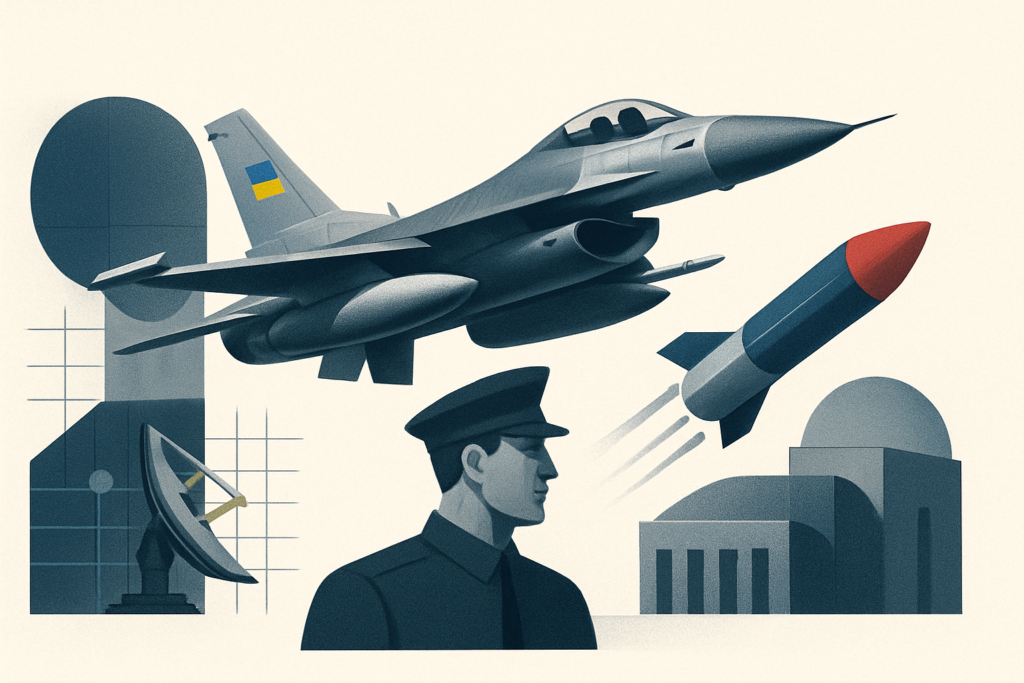
US Joint Chiefs Chair Gen. Dan Caine recently told Congress that Ukrainian F-16s scored an air-to-air kill against a Russian fighter — a statement that military technologists say reflects more than pilot skill. The report, which lacks operational detail, nonetheless highlights the transformational role of modern avionics, sensor fusion, datalinks and weapons integration in turning older airframes into contemporary combat nodes inside a layered air‑defense system.
What modern F-16 avionics and sensors bring to an engagement
The baseline F-16 airframe dates to the 1970s, but many Western-variant F-16s have been upgraded with contemporary mission systems. Key elements that materially improve air‑to‑air capability include advanced radars (notably AESA on newer retrofit kits), modern mission computers, and integrated helmet and heads‑up cueing. Those systems increase detection range, target tracking fidelity and pilot situational awareness.
Equally important is sensor fusion — the software layer that combines radar returns, infrared search-and-track (IRST) information, electronic‑support measures and datalinked tracks into a single tactical picture. Sensor fusion reduces cognitive load on pilots, shortens target ID timelines, and enables faster, more confident firing decisions in contested environments.
Targeting pods and infrared sensors give F-16s a non‑radar means to detect and track targets, useful against low‑observable or radar‑quiet threats. At the weapon end, compatibility with beyond‑visual‑range (BVR) missiles and modern short‑range missiles with helmet cueing and high off‑boresight capability make a decisive difference in an air‑to‑air fight.
Weapons integration and the role of datalinks
Integration matters as much as sensors. A networked F-16 can accept fire‑control information from airborne or ground sensors, assign the optimum missile, and employ the most appropriate seeker mode. Datalinks such as Link‑16 (or national equivalents and classified solutions) allow fighters to share tracks, extend situational awareness, and execute cooperative engagements. In practice, that means a missile can be cued by another platform’s radar while the launching fighter remains masked or positioned advantageously.
Software upgrades to mission computers and weapon control systems are a force multiplier: they enable new missile firmware, fuse multiple sensor inputs for more accurate targeting, and manage seek‑and‑strike sequences automatically. For forces integrating Western jets into an existing, mixed fleet — including legacy Soviet systems — these software layers are crucial for interoperability and timely responses.
How layered air defenses and distributed sensing enable fighter success
Gen. Caine framed the kill as evidence of Ukraine’s scaled layered defense. In modern practice, layered defenses combine ground‑based radars and SAMs, dispersed short‑range shooters, persistent ISR (including drones), airborne early warning and fighters. Each layer covers different ranges and altitude bands; together, they create redundancy and multiple engagement options.
Fighters integrated into that mesh can be cued by ground radars or remote sensors, shortening time‑to‑target and reducing the need for risky on‑station searches. Distributed sensing also enables flexible tactics: a fighter can be vectored into a short window where a hostile aircraft is vulnerable, or launch a BVR shot using a third‑party track. That interplay between platforms is as pivotal as any single system upgrade.
Implications for air‑combat technology and countermeasures
The reported engagement reinforces several trends in air‑combat technology. First, avionics and software modernization of legacy airframes remains cost‑effective: a modernized F‑16 can produce combat outcomes comparable to much newer designs in certain mission sets. Second, networked warfare — the ability to fuse and distribute sensor data quickly — amplifies the effectiveness of each node in the system.
It also sharpens the arms race in countermeasures. Electronic warfare suites, advanced radar warning receivers, towed decoys, multispectral IR countermeasures and improved missile seekers are all responses to the connectivity and lethality of modern fighters. On the other side, passive detection (IRST), improved signal processing and multisensor fusion aim to blunt stealth and radar avoidance tactics.
Finally, the engagement underscores that operational doctrine and logistics matter: pilot training, sustainment, tactics development and secure datalink architecture are required to turn upgraded sensors and weapons into combat success. Technology alone is rarely sufficient without the human and institutional layers to exploit it.
What we still don’t know
Important caveats remain. Gen. Caine did not disclose the location, timing, or the type of Russian aircraft involved, and public reporting does not provide verifiable forensic details of the kill. That means analysts must avoid over‑specifying which systems or missiles were used. Still, the broad technological factors described above plausibly explain how an upgraded Western fighter embedded in a layered, networked defense could succeed in an air‑to‑air engagement.
Whether this single reported incident marks a persistent shift in air superiority dynamics depends on scale: the number of modern fighters deployed, the robustness of their supporting sensor network, sustainment under combat attrition, and adversary countermeasures. For now, the claim serves as a practical demonstration that avionics modernization, weapons integration and networked operations can materially change battlefield outcomes even on long‑serving platforms.
Source: Business Insider