
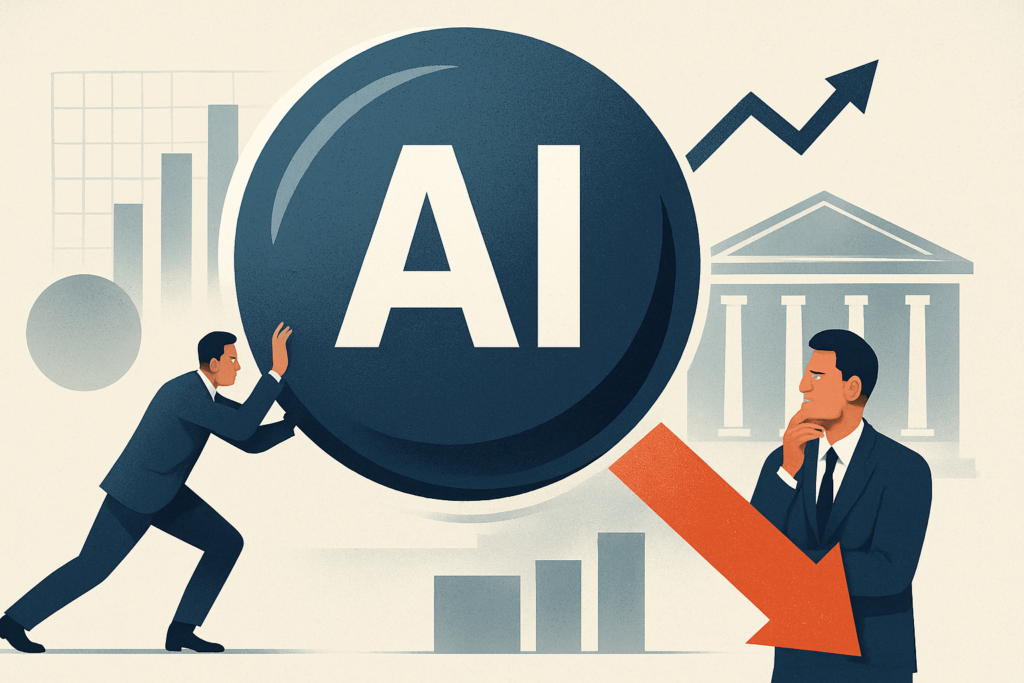
The U.S. stock market has experienced a dramatic upswing powered by artificial intelligence, but the rapid rise in valuations is prompting growing alarm among financiers, regulators and industry figures. Over the past three years, companies tied to AI have added roughly $27 trillion in market value—about 36 percent of the entire U.S. stock market—raising questions about whether current prices are supported by realistic profit expectations.
How AI spending has fueled the rally
Corporate spending on AI has been intense and visible. Major technology firms have taken on large amounts of debt to hire AI talent, buy specialized chips and other hardware, and expand data-center capacity. That investment has helped to drive growth in market capitalizations for both established tech companies and newer AI-linked firms.
At the same time, a flow of private capital has chased AI startups. Investors and financiers have been deploying large sums into early-stage companies, sometimes backing ventures that lack clear near-term paths to profitability. Those deployments have helped lift valuations across the sector and contribute to the overall market surge.
Who is sounding the alarm
The scale of the increase has attracted scrutiny. Analysts at Goldman Sachs—Dominic Wilson and Vickie Chang—have cautioned that the profit growth baked into current valuations requires unusually optimistic assumptions. Sam Altman, a prominent industry leader, has also said the market shows signs of a bubble.
On the institutional side, the International Monetary Fund has flagged the AI valuation run-up as a potential risk to financial stability. The IMF warns that if the rally reverses, the economy could face familiar ripple effects: reduced investment, tighter credit conditions, lower consumer spending and disrupted trade flows.
Why this bubble looks different
Observers note several features that distinguish the current AI-driven expansion from past market bubbles. Historically, bubbles have often been fueled by retail investors and cheap credit. The present episode has been driven largely by very large corporations and institutional capital rather than small, individual investors.
Another key difference is that much of the corporate-financed expansion occurred while the cost of credit was comparatively high rather than at rock-bottom rates. That could, in theory, make the structure of the bubble less fragile: well-capitalized companies and institutional backers may be better able to ride out downturns than highly leveraged retail investors. Still, that resilience does not erase the risk of substantial economic pain if valuations revert and investment dries up.
Structural concerns beneath the headlines
Beyond headline valuations, market watchers point to specific structural worries. Some large tech firms now depend on revenue streams linked to other tech companies, creating interdependencies that could amplify a downturn. Separately, a number of non-tech companies have invested heavily in AI initiatives without demonstrable returns to date, raising questions about the timing and scale of corporate AI adoption.
Private financings have also concentrated capital in startups whose business models remain unproven. When capital is allocated to ventures lacking near-term profitability, the broader market becomes more sensitive to shifts in investor risk appetite.
Possible fallout and indicators to watch
If a correction were to occur, the IMF highlights several channels through which the impact could spread. Lower investment and tighter credit would likely slow hiring and capital projects. Reduced consumption could follow as households and businesses recalibrate spending. International trade flows may be disrupted as demand and supply patterns shift.
Market participants and policymakers will be watching several signals closely: changes in corporate borrowing and capital expenditure, shifts in private financing activity for startups, and any sudden revaluations among the largest AI-linked firms. How companies report progress on AI projects—and how quickly those projects translate into sustainable revenue and margins—will also be critical.
A prudential pause, or a persistent shift?
The debate now centers on whether the current environment reflects a temporary exuberance that will correct sharply, or a structural transformation in which AI generates sustained earnings that justify today’s prices. Some analysts argue the latter is possible, but voices including Goldman Sachs’ Wilson and Chang stress that doing so requires an unusually optimistic view of profits.
For policymakers and investors, the immediate task is to balance the potential economic benefits of AI-driven innovation with vigilance for financial stability risks. The distinctive characteristics of this episode—corporate-led spending at a time of relatively costly credit—could mean a longer, more complex cycle than past bubbles. But the eventual adjustment, whenever it comes, is still likely to impose real costs on companies, investors and the broader economy.
Source: The Atlantic