
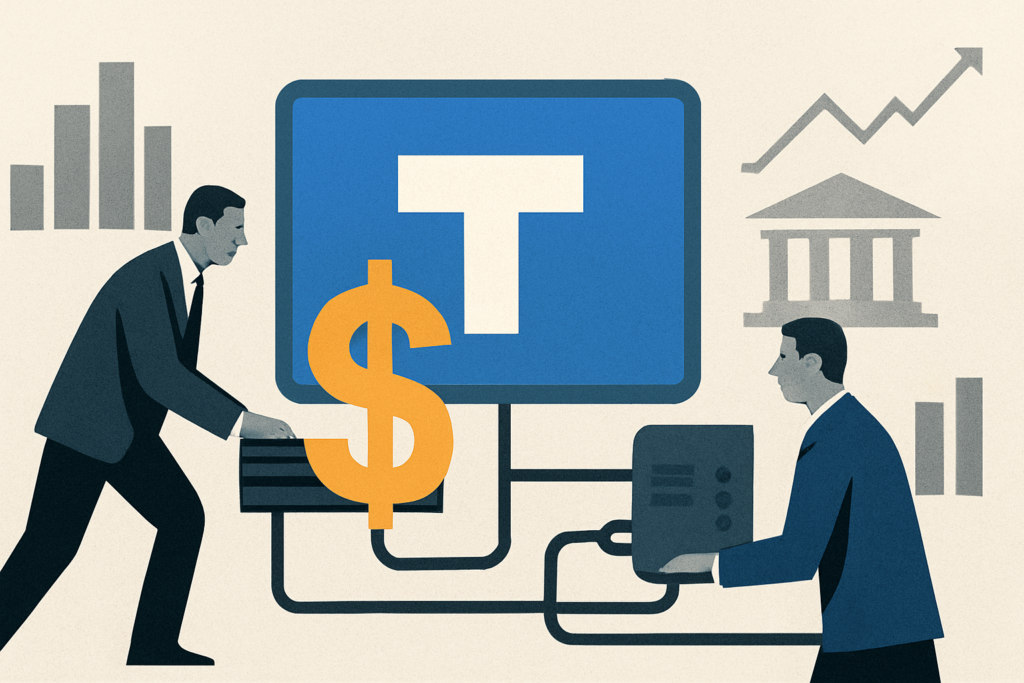
The Wall Street Journal reported that certain Wall Street firms are paying as much as $100,000 a month for expedited access to Truth Social posts. The payments buy automated, near-real-time feeds that traders and quant teams convert—via bots and data pipelines—into market alerts and trading signals.
WSJ finds paid fast-track feeds and automated conversion into trading signals
The Journal’s reporting, published 25 July 2026, says intermediaries are selling faster delivery of posts from Truth Social to financial firms. According to the report, buyers are not relying on manual monitoring; instead, they receive feeds that are ingested automatically by software systems. The feeds are then processed by bots and pipelines that the buyers use to generate market-moving alerts or trading signals.
WSJ framed these arrangements as a commercial service: firms pay for lower-latency access to content that can be used to trigger trading activity sooner than competitors who consume public timelines through ordinary means.
How the feeds and automation are used
The Journal describes a flow in which posts from the social platform are delivered into downstream systems under commercial terms. Purchasers route that stream into software that filters, scores and converts posts into structured alerts or indicators for traders and algorithmic engines. WSJ’s account emphasises automation—software bots and pipelines do the ingestion and the initial conversion to signals rather than human analysts.
The report indicates the outputs are used in two practical ways: to inform human traders via alerts, and to feed trading desks or algorithmic systems that act on signals. WSJ does not provide technical schematics or name specific vendors in the public summary, but the core change reported is the replacement of slower, manual monitoring with a paid automated feed that shortens the time between a post and market action.
Why it matters
The development matters for market participants and platform operators because it compresses the time between a social-media post and trading response. WSJ’s reporting highlights that firms willing to pay for faster delivery can gain an informational edge: they receive and automatically process posts faster than market participants using public or standard access methods.
For platform operators and third-party vendors, the story raises questions about how access is sold, whether the arrangements create privileged data pathways, and how that influences market fairness. For regulators and exchanges, faster, automated ingestion of off-exchange social content into trading decision chains connects platform access practices to market-moving activity, which is a material intersection of technology and finance.
Market and regulatory context and implications
WSJ’s account ties several issues together: commercialised data access, automated processing, and market impact. The reported model—paying intermediaries for lower-latency feeds that are fed into bots and trading systems—creates a direct link between platform content and trading decisions. That link elevates the technology question about how platforms provide data and the business question about who can afford faster access.
Although WSJ does not report on enforcement actions or rule changes in the piece, the situation touches on existing oversight areas. Regulators that monitor market manipulation and fair access could examine whether preferential delivery of social content to paying traders constitutes a new vector for asymmetrical market information. Exchanges and compliance teams will likely want to evaluate how these automated signals are generated and whether they introduce novel risks—such as erroneous alerts, spoofed content, or misuse of platform data—into trading systems.
What to watch next
Key open questions remain. WSJ’s reporting identifies the commercial practice but leaves several operational and regulatory points unresolved. Watch for: (1) whether Truth Social or intermediaries disclose formal API or commercial terms that permit prioritized delivery; (2) whether vendors or buyers named in follow-up reporting reveal technical details about how posts are filtered, validated and translated into signals; (3) whether exchanges or regulators open inquiries into whether paid, low-latency access to social content affects market fairness or falls into existing oversight frameworks.
Also monitor whether firms advertising these feeds disclose error handling, provenance checks or throttles designed to prevent false or manipulated posts from generating automated trades. The robustness of validation in those pipelines will influence how material the market risk is in practice.
The Wall Street Journal’s report focuses attention on a straightforward technical-commercial change: paying for faster feeds from a social platform and feeding those posts into automated trading pipelines. That change compresses information latency and turns social posts into actionable inputs for traders faster than before.
Source: WSJ