
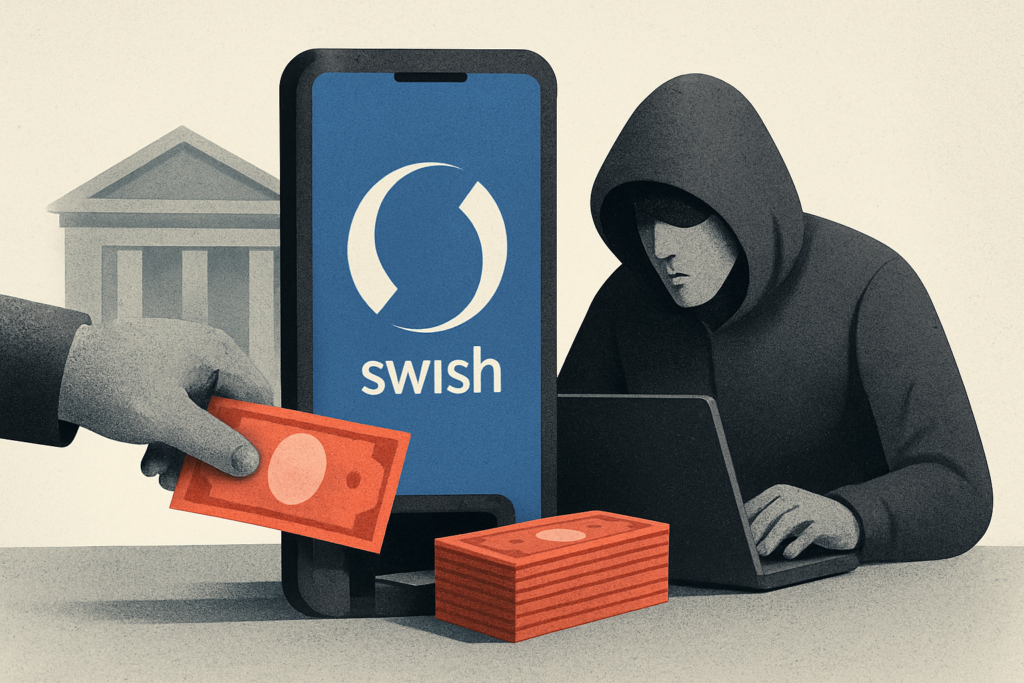
Svenska Dagbladet reports that ordinary Swish users in Sweden are being targeted to receive peer‑to‑peer transfers and convert them into cash, a pattern that can expose recipients to money‑laundering charges. The paper describes a Stockholm case and cites official statistics showing a sharp rise in convictions for money‑laundering among young people.
Swish transfers tied to rising money‑laundering reports and a reported Stockholm case
The newspaper describes a case in which a 53‑year‑old Stockholm man, identified as Mattias, was asked to help pay for another person’s hairdresser visit by accepting a Swish transfer and withdrawing the funds. SvD says Mattias “kunde ha gjort sig skyldig till penningtvättsbrott” — he could have been guilty of a money‑laundering offence. Mattias told the paper: “När man blir överraskad hinner man inte tänka efter.” (When you are surprised you do not have time to think.)
SvD also reports that the number of reported money‑laundering offences has increased steadily in recent years. It cites figures from Brottsförebyggande rådet showing convictions in the 15–19 age group rose from 179 to 541 over five years — a 200 percent increase — indicating a change in who is being prosecuted for these crimes.
How the Swish “trap” works in reported cases
According to the SvD account, the modus operandi involves sending Swish payments to private individuals and asking them to withdraw the money in cash. The recipient is then expected to hand over the cash or otherwise pass it on. In the Stockholm example, the recipient was an ordinary citizen asked to assist with an everyday purchase, which is what created the risk of unwittingly participating in a criminal scheme.
The article emphasizes the element of surprise and social pressure: targets may be asked in person or in public settings and can be caught off guard, reducing the time they have to assess whether the transfer is legitimate.
Why this matters
SvD’s reporting highlights three immediate consequences. First, ordinary users of mobile payment apps can face criminal liability simply by accepting funds and withdrawing cash at someone else’s request, as shown by the described case. Second, the reported jump in convictions among 15–19‑year‑olds signals a shift in offender demographics that could affect how authorities prioritise investigations and how banks flag suspicious behaviour. Third, the method leverages commonplace features of instant peer‑to‑peer payments — quick transfers to private accounts — creating a venue for laundering that relies on everyday behaviour rather than formal bank accounts or shell companies.
These facts matter for consumers, banks and law enforcement: consumers need clarity about legal exposure, banks must decide how to detect and escalate suspicious P2P transfers, and prosecutors and courts will face more cases that involve ordinary citizens rather than clearly criminal intermediaries.
Banking controls, detection and policy trade‑offs
The SvD piece does not provide detail on how banks or Swish operator(s) are responding, but the reported rise in cases implies trade‑offs for payment providers and regulators. Stricter monitoring of P2P transfers could catch laundering but may also slow or complicate legitimate consumer use. Conversely, keeping low friction for everyday transfers can leave a surveillance gap exploited by criminals.
The change in offender age profile — a 200 percent increase in convictions among 15–19‑year‑olds over five years — raises specific questions about recruitment, exploitation and whether current detection thresholds and reporting practices capture newly emerging patterns. The article’s account of an older, unwitting victim also highlights that vulnerability spans ages and user types.
What to watch next
The SvD report leaves several open questions that will determine how this pattern evolves and how institutions respond. Key items to monitor include whether banks or the operators of Swish change transaction monitoring rules for small, rapid P2P transfers; whether public guidance or consumer warnings are issued to clarify when accepting a payment may be criminally risky; and whether prosecutors or police publish guidance after increasing numbers of cases involving ordinary users.
Also unresolved is whether the rise in convictions among teenagers reflects greater enforcement, a genuine shift in offending behaviour, or both. SvD’s reporting does not detail follow‑up measures from financial institutions or regulators, so the scale and timing of any operational changes remain uncertain.
Finally, the article signals a practical risk for individuals approached in public to accept transfers: surprise and social pressure can short‑circuit judgement, creating exposure even when there was no prior intent to commit wrongdoing.
SvD’s reporting frames a clear, practical problem: everyday features of instant mobile payments are being used as a simple channel for laundering, and both users and institutions are now confronting how to respond without unduly disrupting common payment flows.
Source: Svenska Dagbladet