
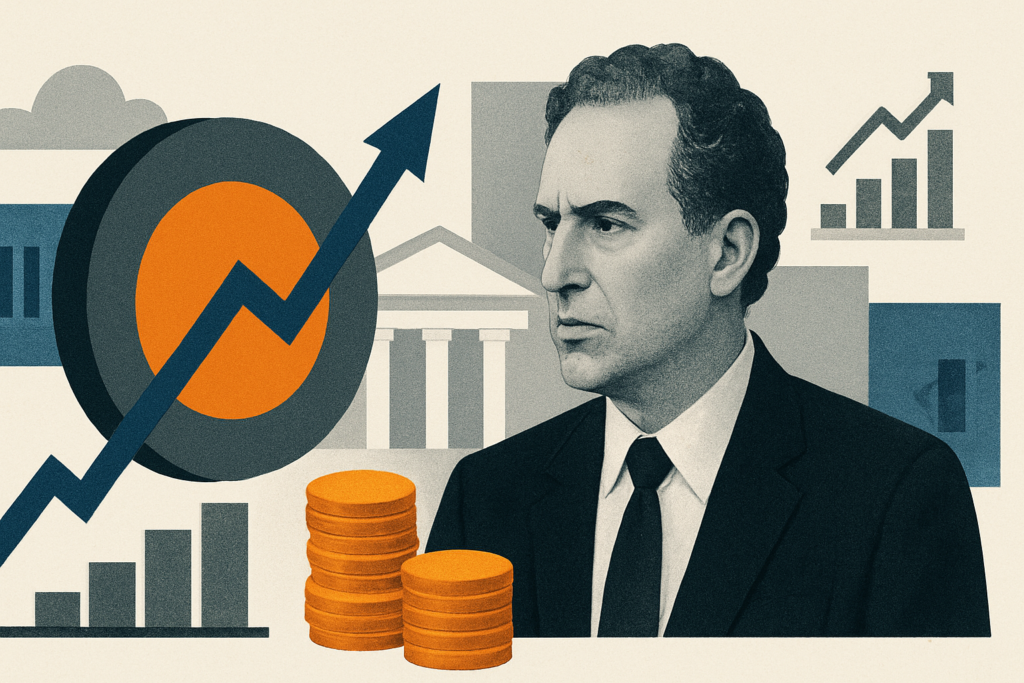
Palantir CEO Alex Karp told the “MD Meets” podcast in July that artificial intelligence will produce “unimaginable wealth” for a small group of people and could widen social inequality, even as he argued that most people’s living standards will still rise. Karp framed the key commercial challenge as turning large language models and other AI into practical software that organisations can deploy — a space where Palantir says it is active.
Alex Karp warns AI could hypercharge wealth concentration
Speaking to host Mathias Döpfner on the “MD Meets” show in July, Karp said AI is “a natural resource that’s, on balance, excruciatingly valuable for humanity, but it has negative externalities.” He predicted that while many people’s pay could rise, the people building and commercialising AI could become “10 to 100 times wealthier than they already are,” creating a dangerous gap. Karp described the phenomenon bluntly, saying a complete decoupling of extreme wealth from everyday life risks tearing the “social fabric.”
His remarks included a memorable line about the profile of winners: the people who acquire these outsized gains may be “oddly shaped IQ specimens you wouldn’t want to have over for dinner,” a comment Karp said was “inflammatory” but illustrative of the social distance he sees forming between creators of value and the rest of society.
Palantir’s pitch: deployable software, not just models
Karp contrasted the hype around large language models with the practical work Palantir focuses on. He compared LLMs to “uranium,” arguing they are immensely valuable but require responsible handling and practical tooling to deliver long-term impact. According to Karp, the decisive factor for AI’s effect on organisations will be software that helps companies integrate models into operations — not the models alone.
The article notes that companies like Palantir are positioning themselves to help businesses “put artificial intelligence to work,” providing the systems and integration layer needed to turn model capabilities into everyday workflows. Karp emphasised that commercial success will depend on that next layer of software which operationalises AI in enterprises.
Why it matters
Karp’s comments matter for three overlapping groups: enterprise customers, investors and policymakers. For organisations buying AI, his framing reinforces the commercial argument that raw model capability is not the same as production-ready AI: deployment, governance and integration are distinct products. For investors, Karp’s prediction of extreme wealth concentration suggests winners could capture outsized returns, a point he used to explain why attention around companies that own the deployment layer will intensify.
For regulators and public-interest stakeholders, Karp’s warning about the social consequences of concentrated AI wealth reframes the debate away from pure technical risk toward questions about distribution and social cohesion. He tied messaging from AI labs to public fear about job losses, saying leaders in those labs have amplified the perception that average lives will “suck” as they become wealthy — a dynamic he sees as politically combustible.
Context and implications for Palantir and the AI market
Karp packaged his remarks as neither an attack on wealth nor a rejection of AI’s benefits. He said he has been a Democrat for much of his life and described himself as a “’70s progressive” who wants to help the poor while not seeking to “burn the rich.” Within that framing, his public comments serve several functions: they signal Palantir’s view that responsible, enterprise-focused software is the critical commercial answer to AI, they position the company as a mitigator of risk, and they broadcast a nuanced political stance intended to appeal to customers and regulators.
The “uranium” comparison underscores Palantir’s pitch for careful handling and governance. It also signals that the company sees potential regulatory or reputational consequences from how AI winners behave and communicate. Karp’s critique of industry messaging — that lab executives have stoked public fear over job losses — highlights a reputational dimension that could influence corporate communications and product positioning across the sector.
What to watch next
Several open questions remain. Will Palantir change its product messaging or offerings to foreground distributional concerns and social safeguards? The source does not provide details on new products or timing, so that remains uncertain. Watch for Palantir earnings calls, press releases or client announcements that explicitly tie deployment tools to governance and fairness features.
Regulators and policymakers could respond to public debate about concentration and messaging, but the article does not report any specific policy actions linked to Karp’s remarks. Also uncertain is how investors will react: Karp’s comments could sharpen investor focus on companies that claim to operationalise AI rather than on the labs that build base models.
Karp’s on-record warning reframes part of the AI commercial argument: the technology may lift many living standards while simultaneously concentrating vast wealth among a small, socially distant group — and the companies that build the deployment layer will be central to how that story unfolds.
Source: Yahoo Finance