
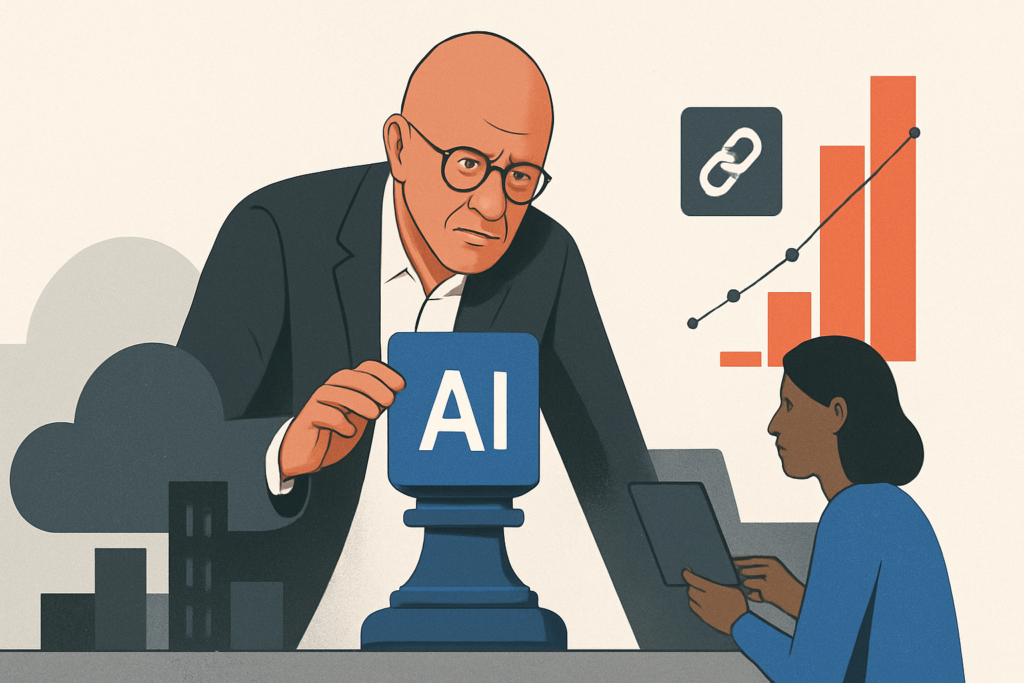
Business Insider reports that Satya Nadella’s all-in AI strategy has created a company-wide squeeze: record capital spending and prioritisation of Microsoft’s own AI products have strained Azure capacity, disrupted GitHub reliability, and forced executives to make sharp trade-offs affecting customers and employees.
Microsoft’s AI push, Azure growth and product troubles — the confirmed facts
Business Insider’s reporting lays out a sequence of developments through the current financial year. Microsoft is planning roughly $190 billion in capital expenditures largely aimed at data-centre and AI infrastructure. The company’s stock is down more than 24% over the past 12 months, and investors have questioned whether Microsoft’s multibillion-dollar AI bet will deliver.
Several of Microsoft’s flagship businesses are flagged as under pressure. Copilot is described as trailing competitors like ChatGPT and Claude, LinkedIn has drawn criticism for AI-generated low-value content, and Xbox leadership has acknowledged the business is “not healthy,” with layoffs and restructuring following the Activision Blizzard acquisition. Microsoft reported about $75 billion in Azure revenue for fiscal 2025, and executives told Business Insider that Azure growth was 39% this past year.
Inside the company, executives and employees told Business Insider they are contending with repeated GitHub outages as AI usage surged, increased sales quotas (some raised by as much as 30%), and leadership and performance-review changes tied to the AI pivot.
How Microsoft is reallocating compute, sales quotas and partnerships
Business Insider documents a clear prioritisation: Microsoft is allocating newly available GPUs and other capacity first to its own AI products — notably M365 Copilot and GitHub Copilot — then to long-term R&D, and finally to Azure customers. CFO Amy Hood is quoted saying the firm is “solving for the increased usage in sales and the accelerating pace of M365 Copilot, as well as GitHub Copilot” before serving broader Azure demand.
That internal priority appears to have practical effects. Hood told investors that if GPUs that came online in the first half of the fiscal year had been devoted to Azure rather than Microsoft’s own products, Azure growth would have exceeded 40% instead of 39%, a point that triggered investor concern when disclosed after earnings.
To relieve capacity shortfalls Microsoft has also explored outside options. Business Insider reports the company considered leasing capacity from Oracle but backed away over security and compliance concerns, accepted emergency help from Amazon after GitHub outages, and is evaluating additional capacity from Amazon and Google. Inside Microsoft, executives say they are “shopping for capacity everywhere.”
Why it matters
The reported choices have concrete consequences for customers, developers, and investors. Enterprise Azure customers face longer waits or constrained access to AI-ready compute if Microsoft continues to prioritise first-party products. Developers relying on GitHub confront reliability risks tied to increased AI traffic and repeated outages, and competitive pressure from AI-native coding tools has already prompted discussion inside Microsoft about overhauling GitHub.
For investors, the trade-off between near-term support for Microsoft’s own AI services and broader Azure growth has immediate financial implications: slower reported Azure momentum can depress sentiment even while the company spends heavily to build future capacity. For employees, Business Insider describes sharper performance distinctions, a simplified five-category review system that feels more like stack ranking, and internal cultural pressure tied to efficiency and headcount changes.
Leadership reshuffle, culture and product trade-offs
Business Insider reports Nadella has reshaped Microsoft’s leadership to focus engineering on AI while elevating commercial leadership. Judson Althoff was promoted to a broader commercial role, Mustafa Suleyman’s remit narrowed to superintelligence efforts, and other senior product leaders have left or moved roles. The company is also positioning new sales leaders and rising stars to manage large AI sales units.
Those personnel moves are coupled with sharper managerial directives: managers have been instructed to reduce high-level engineering roles and flatten parts of the organization. Several sources quoted by Business Insider describe a reversion to tougher management practices and internal friction as resources are redirected to AI priorities.
What to watch next
Business Insider identifies several unresolved questions and near-term milestones to monitor. Microsoft’s upcoming quarterly earnings will provide a fresh test of investor confidence and give more detail on Azure growth and AI-related spending. The company’s ability to bring additional data-centre capacity online as planned — and whether it opts to lease more third-party cloud capacity — will be decisive for customers waiting on GPU access.
Other key unknowns reported by Business Insider include whether GitHub’s reliability will stabilise as usage rises, whether product changes to GitHub will be announced to counter AI-native competitors, and how customers will react if Microsoft continues to prioritise internal AI services over external Azure demand. Internal morale and the effects of the new performance-review system are also flagged as operational risks.
Business Insider’s reporting makes clear there is significant uncertainty about how Microsoft will balance acting as an AI platform provider with operating the AI products that depend on that platform.
Microsoft’s AI-driven capital and product decisions are reshaping where compute goes, who gets priority access, and how the company organises around AI — with immediate consequences for Azure customers, developers on GitHub, employees, and investors.
Source: Business Insider