
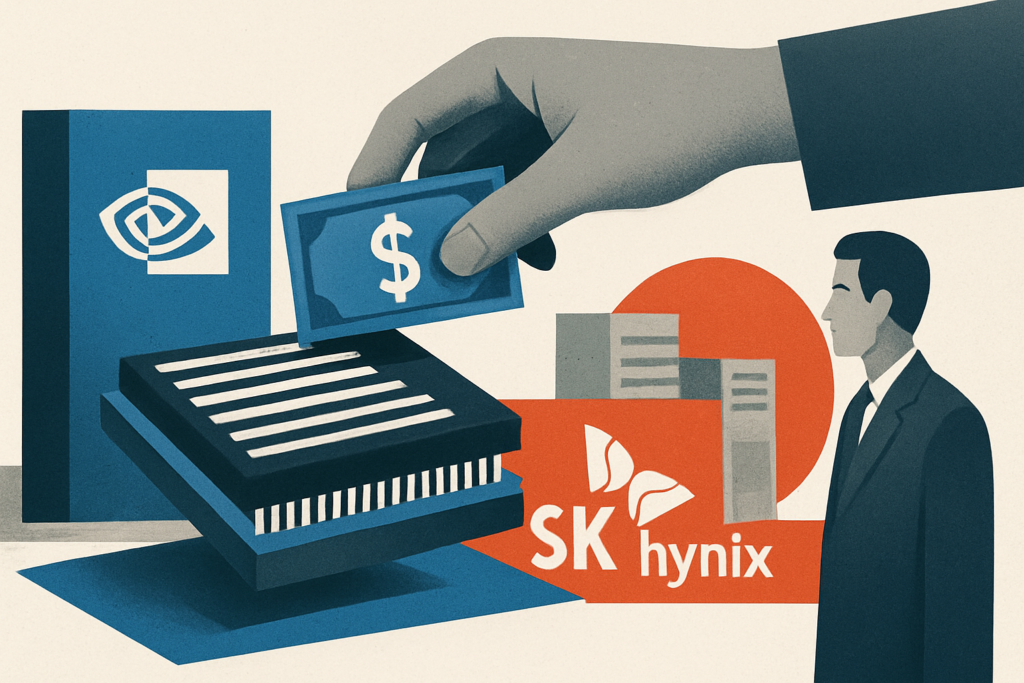
Nvidia announced a multi-year agreement with SK Hynix that locks preferential access to high-bandwidth memory (HBM) and DRAM for its datacenter GPUs and systems. The pact — described by Nvidia as potentially worth $500 billion over several years — also ties memory supply to a large-scale datacenter buildout and new cloud services using Nvidia’s Vera Rubin systems, affecting cloud providers, AI hardware OEMs and memory markets.
Nvidia and SK Hynix sign multi-year memory and datacenter pact
The agreement was announced at an AI summit in San Francisco and, according to Nvidia, could be worth as much as $500 billion spread over multiple years. Nvidia said the deal secures AI memory supply from SK Hynix, a company the article identifies as a leader in HBM production. The pact includes the construction of large-scale datacenters expected to come online in 2027, and an SK Hynix affiliate, SK Telecom, will build a cloud business that runs on Nvidia’s Vera Rubin systems.
On a call with reporters, Nvidia enterprise vice president Raj Mirpuri said the expansion will include a co-development opportunity on next-generation SK Hynix AI memory that “will help us secure a stable supply of HBM memory.” Nvidia also said it is targeting enough capacity in the buildouts to require 2 gigawatts of power, a scale Nvidia says implies a deployment of hundreds of thousands of GPUs.
How the supply and buildout are structured
Details released by Nvidia describe a package of memory supply and infrastructure commitments rather than a single cash transaction. The arrangement ties HBM and DRAM capacity to planned datacenter construction and cloud services: SK Telecom will use Vera Rubin systems to run a cloud business, and Nvidia will invest in regional partners to accelerate access to capacity.
Separately, Nvidia said it would invest $1 billion into Naver to support data centers built around Nvidia GPUs; that project is intended to provide customers an opportunity to secure AI computing capacity before Naver completes 200 megawatts of capacity. The CNBC report also notes a related industry move: Samsung Electronics signed a memorandum of understanding with Broadcom to expand collaboration across memory and foundry technologies in an estimated $200 billion package aimed at supporting next-generation AI infrastructure.
Why it matters
Nvidia’s deal directly addresses a core supply constraint for modern AI systems: high-bandwidth memory. CNBC reported the memory market is facing a global shortage and that securing HBM is critical for Nvidia’s GPUs and systems, which in turn power cloud AI services and enterprise deployments. By co-developing next-generation AI memory with SK Hynix and pre-booking capacity tied to datacenter builds, Nvidia reduces its exposure to spot-market shortages for HBM and DRAM.
For cloud providers and hardware OEMs that rely on the same memory pools, the pact could tighten available HBM for competitors while accelerating capacity for partners named in the deal. Developers and enterprise buyers chasing GPU availability may see faster access to capacity from the specific projects mentioned, while others could face upward pressure on pricing or longer lead times, according to the coverage.
Context and implications for the supply chain
The announcement sits alongside other large industry moves. CNBC reported Samsung’s MOU with Broadcom, valued at roughly $200 billion, which is also framed as infrastructure support for next-generation AI systems. The article frames these deals as signs that massive AI infrastructure buildouts are expanding beyond a handful of hyperscalers to include governments and large conglomerates: Nvidia announced the SK Hynix deal at a summit attended by South Korean officials including President Lee Jae Myung.
SK Hynix’s own financing moves are part of the picture: CNBC notes SK Hynix listed on the Nasdaq earlier this month as part of efforts to finance infrastructure development. Together, the supply deals, co-development commitments and capital flows in South Korea point to a regional push to host large-scale AI capacity, with consequences for global memory allocation and competitive dynamics among GPU consumers.
What to watch next
Several important details remain unclear or unresolved in the reporting. CNBC does not specify the contract terms allocating HBM between Nvidia and other SK Hynix customers, nor the precise timeline for how SK Hynix will scale production to meet the tied datacenter demand. The announced 2027 in-service target for the datacenters leaves open the pace of ramp and the interim availability of memory for the broader market.
Other points to monitor include the progress of the SK Telecom cloud rollout on Vera Rubin systems; the timelines and customer access model for the Naver-backed GPU data centers (noted as providing capacity before 200 megawatts are completed); and the market effects of Samsung’s MOU with Broadcom. Regulatory, competitive or supply-chain reactions that would affect non-partner cloud providers and OEMs were not detailed in the report and remain uncertain.
Nvidia’s deal with SK Hynix ties memory supply directly to large-scale infrastructure and cloud projects, reshaping who gets prioritized access to scarce HBM and DRAM resources and concentrating a portion of next‑generation AI capacity in partner-led deployments.
Source: CNBC