
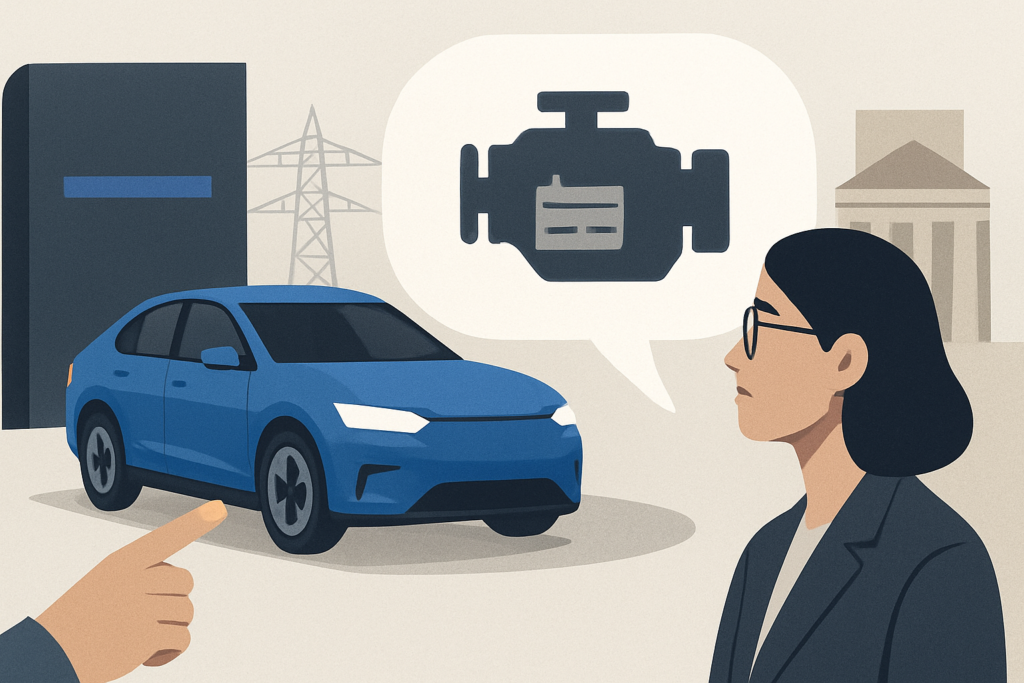
Honda has begun telling current Prologue customers to “consider a hybrid” for their next vehicle as the company shutters its only U.S. EV and shifts its product strategy. The move follows Honda’s decision to end Prologue production after the 2026 model year and to pause several planned U.S. EV programs, a pivot that affects owners, leaseholders and the company’s broader U.S. EV plans.
Honda discontinues the Prologue and alters customer messaging
In July, Honda added a “Consider What’s Next” blurb to monthly account statements that promotes the automaker’s hybrid lineup and explicitly tells customers to “consider a hybrid.” That message landed awkwardly for Prologue drivers: Honda confirmed in mid-July that Prologue production will end after the 2026 model year, with remaining inventory to be sold into early 2027. The Prologue was Honda’s only EV offering in the U.S.
Honda told Business Insider the statement is part of a retention push. “Our focus is on Customer Lifetime Loyalty and retaining all of our existing customers by moving them into new Honda models,” the company said, adding it believes hybrids are “great options” for returning Prologue customers. Several Prologue owners quoted by Business Insider called the note frustrating or ironic.
How Honda’s product choices and program cancellations changed the plan
The Prologue had been intended as a bridge to a wider electric portfolio. It was produced as part of a joint effort with General Motors that also produced the Cadillac Lyriq, Chevy Blazer EV and Chevy Equinox EV. Honda’s longer-term U.S. EV plans have since been scaled back: the company scrapped its planned U.S.-built 0 Series EVs in March and ended a joint venture with Sony before the Afeela sedan reached production.
Honda has said the reassessment of its EV strategy could lead to as much as $15.7 billion in write-downs. Instead of a lineup focused on full battery-electric vehicles in the near term, Honda says it will concentrate on hybrids — outlining a plan for a 15-vehicle global hybrid slate by 2030.
Why it matters
The change is significant for a few groups. Current Prologue owners and lessees who bought into Honda’s EV roadmap are being asked to consider a different technology for their next purchase, a shift some describe as a breach of expectation. For Honda, the pivot represents a large strategic and financial reversal: the company faces inventory, marketing and loyalty implications as it moves away from the EV narrative it had been selling to customers.
For competitors and the market, Honda’s move is another sign of automakers recalibrating EV investment amid higher development costs and slower near-term EV uptake. Business Insider notes other manufacturers have canceled or delayed EV projects and taken big charges. At the same time, macro factors cited in the reporting — including the end of a federal EV tax credit for vehicles acquired after September 30, 2025 — materially changed the economics that helped drive earlier EV rollouts.
Competitive and market context
Honda’s decision sits inside a broader industry reset. Business Insider reported that several automakers, including Stellantis, Ford, Volkswagen and GM, have canceled vehicles, delayed projects or recorded large charges as they respond to weaker-than-expected EV demand and rising costs. The U.S. EV market showed signs of recovery in the second quarter of 2026: Kelley Blue Book estimated 247,226 new EVs were sold in Q2, up 14.7% from Q1 2026, though still below the same quarter a year earlier. That uneven demand picture helps explain why Honda is prioritizing hybrids now.
Owners interviewed by Business Insider expressed practical concerns. Oklahoma owner Benjamin Crabtree said the “consider a hybrid” suggestion was “somewhat laughable,” arguing that most drivers who moved to fully electric vehicles would not want to revert to hybrids. California lessee Kevin Simpson said he felt “let down” after Honda canceled planned 0 Series EVs he had intended to buy.
What to watch next
Key open questions remain. Honda has outlined a hybrid-focused product slate to 2030, but the company’s timetable for reintroducing new full-electric models — if any — is unclear. It is also uncertain how many Prologue owners will accept hybrids versus switching brands for EVs; several drivers told Business Insider they are considering alternatives such as Rivian or other EVs from different partnerships.
Financially, the scale and timing of any write-downs related to the strategy shift are material to Honda’s results; the company itself has flagged up to $15.7 billion in potential charges. Customer retention metrics and lease-return behavior for Prologue vehicles will also be important near-term indicators of how disruptive the pivot is.
Finally, broader EV demand and policy changes — including past eligibility shifts for federal credits — will continue to shape OEM decisions and consumer choices in the coming quarters.
Honda’s messaging swap from “go electric” to “consider a hybrid” crystallises a strategic U-turn that affects owners, the company’s financial outlook and the competitive dynamics for U.S. electric-vehicle adoption.
Source: Business Insider