
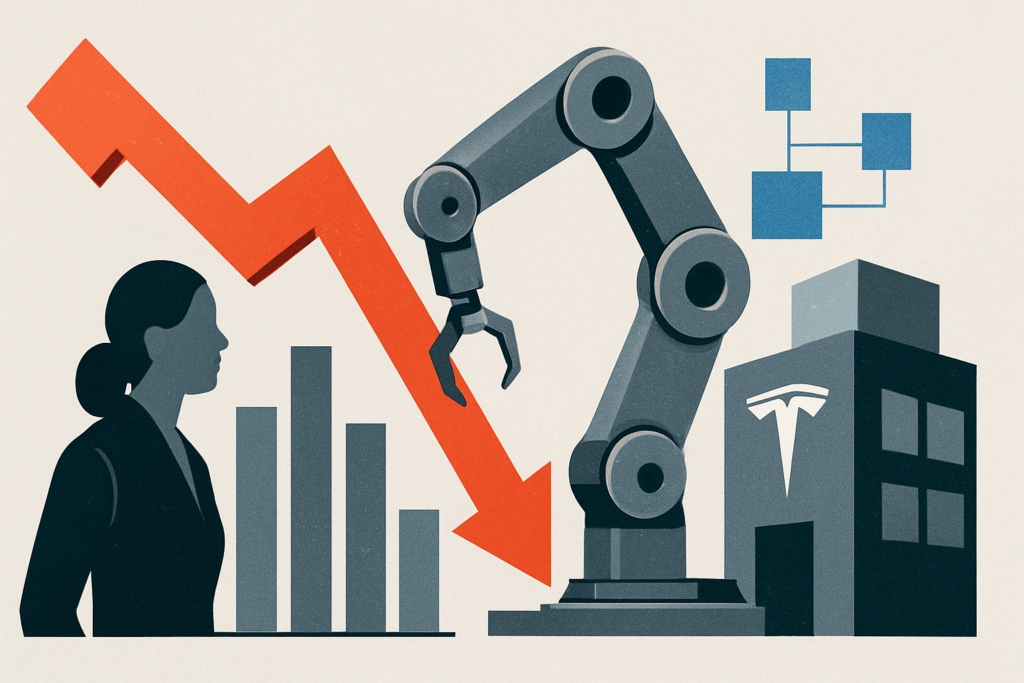
Tesla reported a surprising squeeze on profitability in its second quarter, posting earnings per share well below Wall Street estimates even as revenue climbed. The results underline the tensions in Elon Musk’s shifting priorities: while vehicle sales and broader revenue growth continue, the company is increasingly focused on longer-term bets in robotics, autonomous driving and artificial intelligence.
Quarterly results: revenue up, earnings down
For the three months ended in the second quarter, Tesla registered earnings of $0.31 per share, compared with analysts’ expectations of $0.51 per share. At the same time the company recorded revenue of $28.23bn, topping the $25.71bn that the market had forecast. Shares dipped more than 3% in after-hours trading following the results.
The report comes amid a difficult year for Tesla’s stock: the share price had already fallen about 14% year-to-date prior to the release. The wider Musk portfolio has also seen volatility; SpaceX’s blockbuster public debut last month briefly made Musk the world’s first trillionaire, though that net worth has since retreated and SpaceX shares have declined roughly 26% since the listing.
Sales dynamics and market pressures
Tesla’s sales performance has been uneven. The company said it exceeded expectations for second-quarter vehicle sales earlier this month, a rebound driven largely by strong demand in Europe where subsidies for electric vehicles remain in place. The Guardian report linked higher European demand in part to surging fuel prices tied to the US–Iran conflict, which pushed some consumers toward EV purchases.
Nevertheless, headwinds remain. Tesla has been affected by the end of US electric vehicle tax incentives last year and growing competition from lower-cost Chinese automakers, pressures that have constrained the firm’s traditional vehicle-driven growth model.
Pivot to robotics and autonomous services
As revenue from vehicles competes with margin pressures, Tesla has been reorienting its corporate strategy toward robotics and AI-driven services. CEO Elon Musk has repeatedly framed the company’s longer-term future around products such as the humanoid Optimus robot and a driverless ride-hailing service known as Robotaxi.
Musk told investors that Optimus remains an ambitious objective and that creating an autonomous humanoid capable of performing diverse tasks is “one of the hardest things to solve.” The robot has not entered wide production and already faces competition from Chinese firms pursuing similar hardware and software approaches.
Robotaxi rollout and safety caution
Robotaxi is central to Tesla’s vision for a recurring revenue stream beyond vehicle sales. The company recently expanded the service to Tampa and Orlando, adding to existing operations in parts of Austin, Dallas, Houston and Miami. Despite broad promises in prior years about mass demand and a rapid national rollout, adoption has been measured; Tesla said only about 50 Robotaxis currently operate in Austin.
On the company’s earnings call, Musk emphasized that growth has been deliberately cautious because of safety and regulatory risks. “We’re going as fast as humanly possible in scaling Robotaxi, but while trying to ensure that we do not harm anyone at all, and ideally do not even run over a pet,” he said, stressing a conservative approach to deployment to avoid negative headlines or a regulatory clampdown.
Outlook: transition pains and long-term bets
The latest quarter highlights a familiar tension for companies in deep transition: near-term financial metrics can suffer as resources are diverted to risky, long-horizon projects. Tesla’s revenue growth this quarter suggests the company still generates significant demand for its products, but slipping profits and heightened competition point to margin pressures.
Tesla’s shift toward AI and robotics positions it in fast-moving, capital-intensive markets where technical breakthroughs and scale are critical. The company’s future performance will hinge on whether it can translate engineering ambitions—such as a scalable Optimus and a widely adopted Robotaxi platform—into dependable revenue and profit streams without eroding the core auto business.
Investors watching Tesla will likely focus on a combination of near-term operational metrics—production, unit economics and regulatory developments for autonomous services—and progress on the company’s more speculative technologies. For now, the second-quarter figures underscore that the transition is underway, but it is far from complete.
Source: The Guardian