
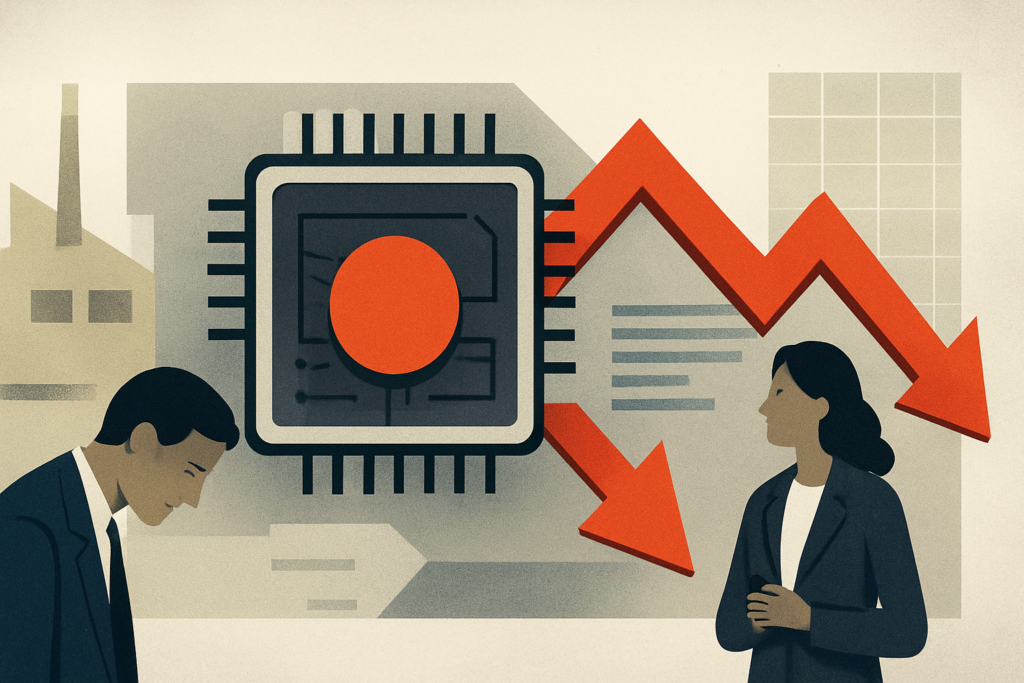
Chip and AI-infrastructure stocks slid during Monday’s trading, pulling technology exposure down even as other parts of the market held up. CNBC’s live market coverage reported weakness across semiconductor names and chip-focused ETFs, a move investors say reflects fresh worries about demand, financing for capital-intensive projects and rising competition.
Semiconductor selloff and where it showed up
CNBC’s live updates on Monday recorded a clear split inside technology: the iShares Semiconductor ETF was trading lower while the iShares Expanded Tech-Software ETF was higher. The two ETFs have moved in opposite directions 32 of the past 60 trading sessions, and their 60-day rolling correlation has fallen to around zero from a long-term average near 0.75, CNBC wrote. That divergence accompanied a broader risk-off in chip- and AI-infrastructure-linked stocks, which also weighed on groups exposed to large capital expenditures.
Drivers behind the move: demand, capex and competition
CNBC’s coverage linked the sector’s weakness to a cluster of investor concerns. Market participants pointed to softer semiconductor demand expectations and the heavy capital spending profiles of AI infrastructure and miner-to-AI developers. Michael Donovan, a senior research analyst cited by CNBC, said investors are worried about whether companies will need to raise incremental capital at higher costs to fund development pipelines, and whether credit appetite for those projects may be stretched.
CNBC also noted intensifying competition from Chinese semiconductor companies as another factor pressuring sentiment. Those worries sit alongside cyclical signals: the Commerce Department’s June durable-goods report — also cited in CNBC’s live updates — showed a 3.1% increase in orders for computers and electronic products, which provides a mixed read on end-market demand.
Why it matters
The selloff matters because the semiconductor sector is tightly linked to the economics of cloud providers, data-centre operators and AI infrastructure builders. Falling chip prices or weaker demand can delay purchases of GPUs and other accelerators that feed AI training and inference workloads, which in turn can affect cloud capex and vendor revenue timing. CNBC’s live coverage highlighted that investor concern over financing and capex can create second-order effects: firms that rely on external capital to scale data-centre and miner-style operations may face higher funding costs or dilution if markets remain unsettled.
At the same time, the same CNBC update contained countervailing signals for cloud demand: Phillip Securities upgraded Alphabet to buy on the back of “record cloud growth,” and Torsten Slok of Apollo told CNBC that AI-driven spending and the data-centre buildout remain an important economic engine. Those points in the same report show the market is weighing near-term semiconductor-cycle risk against continuing structural demand for cloud services and AI capacity.
Market context and implications for the semiconductor supply chain
The split between software and semiconductor performance — now unusually pronounced by historical measures — complicates typical sector allocations and investor theses that once treated software and chips as tightly correlated. For chipmakers, the immediate implication is amplified earnings and guidance scrutiny: if investors expect slower unit demand or elongated inventory digestion, revenue and margin trajectories for suppliers could be re-priced.
For consumers of semiconductor products, including hyperscale cloud providers and data-centre operators, the practical effect depends on timing. If weakness reflects a temporary inventory adjustment, cloud customers could see more advantageous procurement pricing over several quarters. If weakness signals a more structural slowdown or intensifying global competition, suppliers’ business plans and capital-intensity could be reshaped, with ripple effects on supply-chain partners and equipment vendors.
What to watch next
CNBC’s live coverage points to several specific data and corporate events that will clarify whether the selloff is transient or the start of a deeper cycle: upcoming quarterly earnings from major capex spenders in AI and cloud, semiconductor companies’ revenue and inventory disclosures, and any changes in credit conditions for capital-intensive projects. The durable-goods data showing a 3.1% rise in computers and electronic products in June is one datapoint; investors will be watching whether that trend continues or reverses in subsequent releases.
Market participants should also track comments from large cloud vendors and chip suppliers on procurement timing and customer behavior, as well as reports on competition from Chinese foundries and logic-chip makers, which CNBC flagged as a pressure point. Uncertainty remains about the depth and duration of the sector’s weakness — CNBC’s coverage makes clear that both demand signals and financing dynamics will be decisive.
The day’s trading underlined a growing bifurcation inside tech: strong cloud revenue narratives coexist with renewed investor caution about semiconductors, capex and competitive pressure — a mix that will shape investment and procurement decisions in the months ahead.
Source: CNBC