
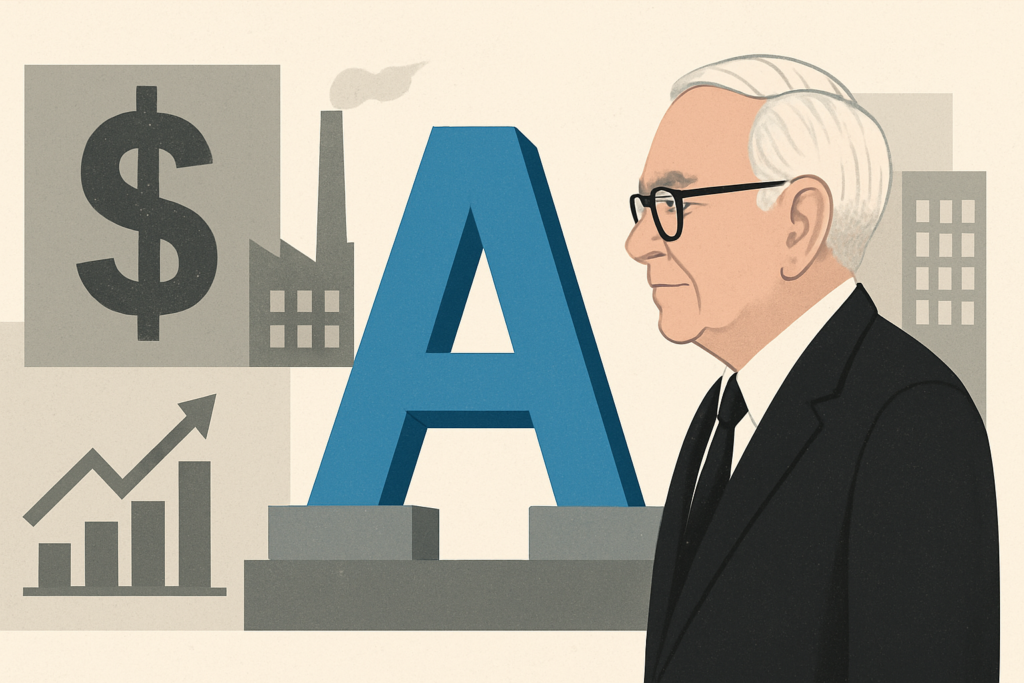
Warren Buffett has acknowledged that he was the driving force behind Berkshire Hathaway’s decision to buy a position in Alphabet, the parent company of Google and YouTube. The admission, made in a recent interview, undercuts initial assumptions that the move reflected a strategic push by Greg Abel as he prepared to assume full-time leadership at Berkshire.
Who pushed for the Alphabet stake?
When Berkshire disclosed a holding in Alphabet last year, many observers viewed it as a sign that the incoming CEO, Greg Abel, had begun steering the conglomerate into larger technology positions. Abel formally took over the CEO role at the start of 2026, and Berkshire’s Alphabet disclosure had been read by some as evidence of a management shift.
Buffett, however, told interviewers that he himself initiated the investment. The revelation is notable because Buffett has long been associated with investments in traditional, consumer-facing businesses rather than cutting-edge or highly specialized technology firms. Still, this is not Berkshire’s first exposure to major technology names: Apple has been a long-standing and large holding, and Amazon has also appeared in the portfolio.
Why Alphabet appealed to Buffett
Buffett has emphasized his preference for businesses he understands. In explaining the Alphabet decision, he highlighted that companies with broad, consumer-facing models—those whose core businesses are familiar and trackable—fit within his investment framework. For Alphabet, the company’s dominant search engine and YouTube platform account for the bulk of its advertising revenue, providing a clear and valuable cash-generating foundation.
Alphabet’s other ventures, such as cloud computing and autonomous-vehicle research, are important but represent areas Buffett appears to view as secondary to Alphabet’s advertising engines. That familiar revenue base, coupled with the company’s scale and competitive advantages, helped persuade him that Alphabet could be evaluated using the same business-understanding principles that have guided Berkshire’s approach for decades.
Buffett’s investment philosophy in play
Buffett reiterated a long-standing tenet: an investor’s risk stems chiefly from not understanding what they own. He stated plainly, “Risk comes from not knowing what you’re doing.” That maxim underpinned his decision to back Alphabet—he judged the company’s primary business to be sufficiently transparent and durable to merit ownership.
The move also reflects a broader theme in today’s markets: many of the largest technology companies have matured into diversified, consumer-facing enterprises whose core businesses can be readily assessed by traditional investors. For Buffett, that makes some tech companies acceptable fits for Berkshire’s investment criteria, even if other technology areas—highly specialized or nascent fields—remain outside his circle of competence.
What this means for investors
Berkshire’s Alphabet position and Buffett’s role in spearheading it serve as a reminder for individual and institutional investors to focus on business fundamentals and clarity. Familiarity with how a company generates cash, the sustainability of its revenue streams, and the size of its competitive moat were central to Buffett’s calculus.
At the same time, the episode does not signal an across-the-board embrace of all technology firms. Buffett’s historical caution about highly technical or opaque businesses remains intact; his investments in Apple and the newer Alphabet stake instead illustrate his willingness to buy into large, comprehensible tech franchises.
Industry reaction and context
The disclosure of Berkshire’s Alphabet holding last year attracted attention both because of Buffett’s reputation and because it came at a moment of executive transition at Berkshire. While markets and analysts debated who within the company had directed the trade, Buffett’s public confirmation settles that question: the decision originated with him.
Independent investment advisors and commentators often draw different conclusions about whether to own Alphabet now. The Motley Fool’s Stock Advisor, for instance, did not include Alphabet among its 10 top stock picks at the time of its most recent list, illustrating that professional investors can reasonably disagree on timing and portfolio fit even when they acknowledge the same underlying business strengths.
For Berkshire shareholders and broader market participants, Buffett’s admission highlights the continuing evolution of his investment selections: he remains guided by long-standing principles rather than fashion, but he is also adaptable when companies meet the criteria he values most—clarity of business model, durable competitive advantages, and predictable cash flows.
As Buffett and Berkshire chart their path under new leadership, the Alphabet investment will likely be examined as a signal of how the company balances traditional value principles with the realities of a market dominated by a handful of very large technology platforms.
Source: Yahoo Finance