
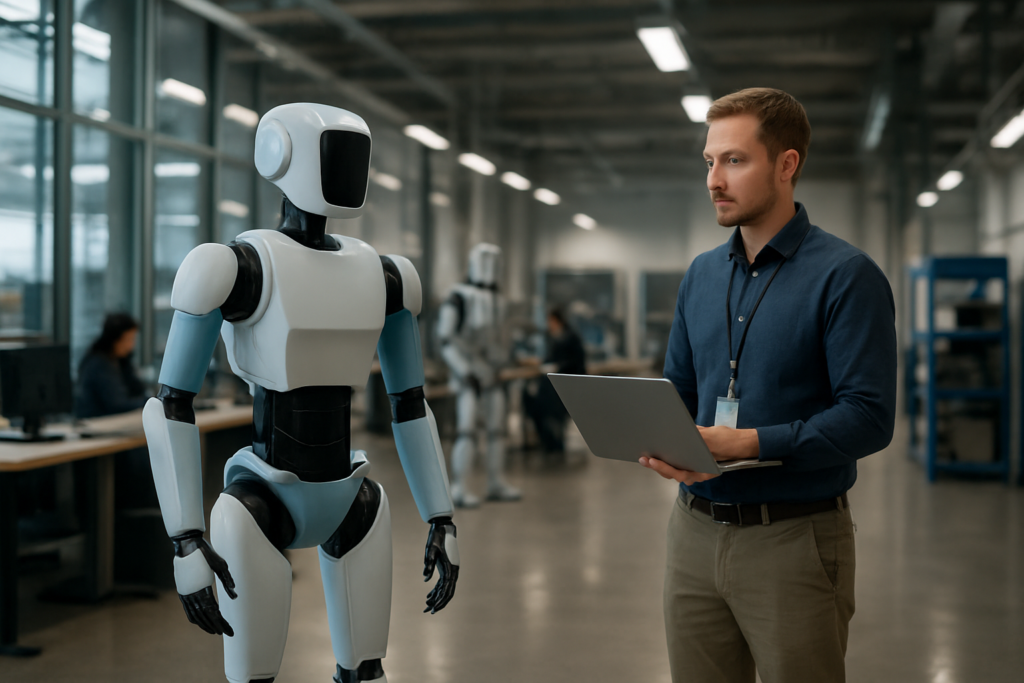
Agility Robotics has opened a 60,000-square-foot training facility in Fremont, California, to accelerate deployment of its bipedal robot Digit in industrial settings. The center sits near Tesla’s planned Optimus manufacturing site and will be used to teach new skills in environments that mirror warehouses and factories, the company says.
From pilots to production: where Digit is being used
Unlike many recent humanoid startups that remain largely theoretical, Agility has already moved into revenue-generating work. Digit is operating in logistics and manufacturing sites carrying totes and bins for customers that include Amazon, GXO, Schaeffler and Toyota Motor Manufacturing Canada. The company reports it has won $300 million in contract orders and says pilots have handled substantial workloads — observers estimate dozens of robots have been used in pilot and early deployments, and Agility has reported Digits moved 100,000 totes at a GXO facility.
CEO Peggy Johnson framed the new training center as a practical step to scale those deployments. She told TechCrunch that having other players in the humanoid space, like Tesla, nearby is beneficial after years of operating largely alone. The facility will allow Agility to test and refine Digit’s behaviors in settings that mirror customer sites, streamlining compliance with safety and IT requirements and integration with warehouse management systems.
Practical autonomy and safety-first design
Agility’s leadership emphasizes a conservative approach to autonomy for safety-critical functions. Co-founder and chairman Damion Shelton cautioned against using generative AI where safety guarantees are required, likening the need for deterministic control to the anti-lock brake controller in automobiles. He told TechCrunch that safety systems should remain on stable, non-generative paths while other layers can benefit from AI.
Still, the company sees AI as a key enabler for scaling applications. Shelton said generative models help address a core challenge: the variety of tasks a robot could perform far exceeds the number of engineers available to program them. In that view, AI tools can expand the set of applications Digit can execute without linearly increasing engineering headcount.
Facility role and product roadmap
The Fremont hub will be a focal point for training and validating behaviors before robots go live in customer sites. Johnson said more than 30 customers are in talks with Agility about deployments, and the training space is intended to shorten the path from pilot to production-ready operation.
Agility plans further product evolution as well. The company has said a version 5 of Digit is expected to be unveiled this fall; this version is slated to include the ability to sense humans and will no longer require operation in human-free zones. For now, Digits operate in environments without people on the floor, reflecting current safety constraints and industry norms.
Public markets and market positioning
Agility is pursuing a reverse-merger that the company says should make it the first pure-play humanoid robot company listed on public markets later this year. Founded in 2015 by researchers who developed methods for reliable bipedal locomotion, Agility has spent years translating walking capability into commercial applications and claims a lead over newer AI-driven entrants in the humanoid space.
The company’s strategy prioritizes practical use cases in logistics and manufacturing. Chief robot officer Jonathan Hurst noted there is a large set of industrial tasks that still need automation — from moving totes and kitting to handling cardboard and loading trailers — and that focusing on those workflows represents substantial near-term opportunity without stretching into consumer markets.
Competition and the broader humanoid landscape
Tesla’s Optimus project has attracted attention as a high-profile rival; founder Elon Musk has said he expects Optimus to become “the biggest product ever” once it proves useful beyond Tesla. Agility’s leadership welcomes the proximity, arguing that commercial deployments and integration work remain crucial differentiators. Peggy Johnson emphasized Agility’s experience meeting safety, regulatory and IT requirements at customer sites as a competitive advantage.
Other startups in the space include Figure, 1X, the Bot Company and Sunday Robotics, many of which are pursuing different technical and go-to-market approaches. Agility’s focus on validated industrial applications and a measured use of AI for scaling application development outlines a path that prioritizes reliability and compliance over speculative consumer deployments.
What to watch next
Key near-term milestones for Agility include rolling more pilots into full deployments from the new Fremont center, the unveiling of Digit v5 this fall, and completion of the planned reverse-merger. How quickly Agility can translate training runs into stable, integrated deployments for its customer pipeline will determine whether its commercial-first approach broadens market acceptance for humanoid robots in logistics and manufacturing.
Source: TechCrunch AI