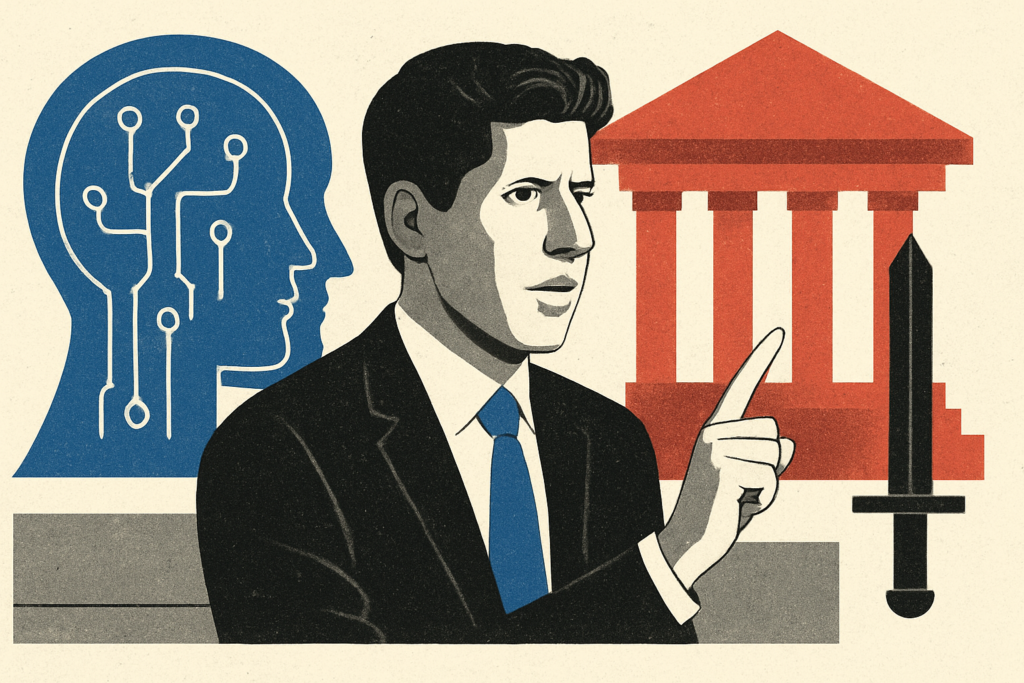
OpenAI CEO Sam Altman told a YouTube podcast audience that “we are now in the singularity,” arguing that the recent pace of AI progress has already produced a decisive change in capabilities. He added a political warning: the moment raises a central choice between a future of AI-enabled authoritarianism or one of distributed liberty, remarks that have reignited debate over AI safety and governance.
Altman’s claim: the singularity is already here and authoritarianism is the threat to watch
Altman made the remarks on the podcast “How to start a startup,” hosted by Ti Morse, saying the AI progress of the past decade has reached a point that used to be a speculative topic and is now “the moment” people once joked about. He described the industry’s trajectory as an exponential curve without a single tipping point, but argued humanity is “in another one of those decisive periods where the curve can go one way or another.”
On the same podcast he framed the core struggle as political: “are we going to head to a world of AI authoritarianism or liberty?” He said that because of safety and economic concerns there is a risk of concentrating a single dominant model or company — a “machine god” — but insisted the alternative should be empowering people to use the technology as society chooses.
Altman’s timelines and past statements
These comments echo a June 2025 blog post Altman wrote called “The Gentle Singularity,” in which he said humanity had passed an “event horizon” in AI development and that a takeoff to digital superintelligence had begun. In that piece he offered concrete near-term forecasts: by 2026, systems would be able to generate genuinely novel scientific insights rather than merely summarising research, and robots performing real‑world physical tasks would be commonplace by 2027. The podcast remarks reiterate that framing and the short timelines he laid out.
Altman also discussed product work at OpenAI, saying he became “addicted to TikTok” while building the company’s Sora video‑generation app. The article reports Sora was shut down earlier this year when OpenAI deprioritised projects ahead of its IPO—an operational detail Altman referenced in describing his reasons for studying short‑form video dynamics.
Why it matters
Altman is one of the most visible corporate voices in AI; his public claim that the singularity is already underway and his framing of an impending political choice are likely to shape conversations among regulators, investors and other companies. His timelines — explicit predictions for 2026 and 2027 made in his blog and reiterated in the podcast — create a near‑term benchmark that policymakers and competitors may use when assessing urgency and standards for safety, deployment and oversight.
His warning about AI authoritarianism narrows the policy question from abstract safety to governance models: if influential industry leaders publicly present the threat as central, regulators may prioritise competition and decentralisation measures as much as technical alignment. Likewise, investors and corporate strategists will read Altman’s emphasis on concentrated risk as a signal about which business models and compliance investments could face scrutiny.
Implications for platforms, safety debates and public trust
Altman’s commentary ties product choices to social outcomes. His anecdote about studying TikTok while building Sora connects concerns about engagement and attention with decisions about what kinds of AI products to develop or pause. The report states OpenAI deprioritised Sora ahead of its IPO, which Altman used to explain why he was analysing short‑form video behavior—an admission that product design trade‑offs informed strategy.
By restating that the path forward is political — whether control is concentrated or distributed — Altman reframes part of the safety debate as a contest over governance and platform design, not only alignment research. That framing may increase pressure on platform moderation policy, business model design and corporate disclosure, because those are levers through which concentration and influence are exercised.
What to watch next
Several open questions remain. Altman’s timeline claims set expectations for 2026 and 2027; observers should track whether OpenAI or others publish demonstrable milestones that match his predictions, and whether regulators treat those timelines as a basis for accelerated rulemaking. The article does not report any new product launches tied to those forecasts, so verification will depend on future technical outputs and company disclosures.
Policymakers and industry groups are likely to respond to the renewed emphasis on governance. The piece notes the remarks have reignited debate among researchers and regulators; watch for concrete regulatory proposals, coalition statements from labs, or changes in platform moderation that cite concentration risks. Finally, Altman’s reference to Sora’s shutdown and the company’s IPO plans suggests corporate strategy and capital markets timing could influence which projects are prioritised or paused—stakeholders should monitor OpenAI’s public communications and filings for changes in product roadmaps or governance commitments.
Altman’s public framing places urgent political choices at the centre of the AI conversation and restates near‑term technical timelines; the near future will show whether those claims translate into measurable capabilities, regulatory action, or shifts in platform and investor behaviour.
Source: The Indian Express