
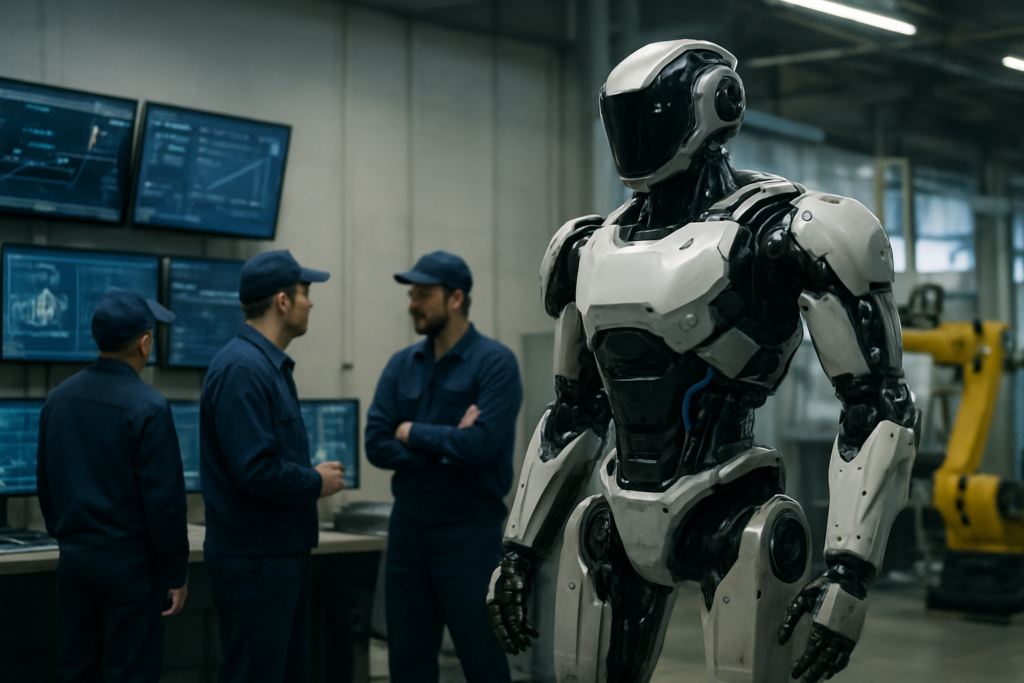
Thousands of Hyundai employees in South Korea have staged partial work stoppages in response to the automaker’s plan to deploy Boston Dynamics’ Atlas humanoid robots across its factories. The walkouts mark the most direct labor confrontation yet over the next wave of humanoid automation in the auto industry and underline rising tensions between organized labor and manufacturers racing to adopt advanced robotics.
Union backlash in Ulsan
Union representatives that cover more than 39,000 Hyundai Motor workers in South Korea said their members cut shifts short by two hours on July 13–15 after negotiations with management failed. Following 15 rounds of talks that did not produce an agreement, the union announced plans for four-hour strikes running July 20–22. The dispute centers on Hyundai’s announced intent to introduce Atlas humanoid robots—developed by Boston Dynamics, which Hyundai is set to acquire as a subsidiary—into production operations.
What Hyundai plans to deploy
Hyundai has said it intends to field more than 25,000 Atlas humanoid robots across Hyundai and Kia facilities, beginning with U.S. factories in 2028. Atlas is a bipedal robot over six feet tall, capable of lifting more than 100 pounds. Industry analysts have offered different cost estimates: a Samsung Securities analyst told Bloomberg that each unit costs about $130,000 and could pay back its purchase within roughly two years of operation. A Macquarie Securities analyst suggested that if unit costs fell to $100,000, operating costs might drop below the U.S. federal minimum wage, potentially undercutting the economics of human roles on the factory floor.
Demands from labor
The Hyundai Motor union has sought concrete protections for workers in response to the automation push. Among its demands are a shift from hourly pay to fixed salaries to shield workers from reduced hours driven by automation, an increase in mandatory retirement age from 60 to 65, and higher bonus payments. These measures aim to preserve income stability even as robotic systems are introduced to handle tasks today done by people.
Metaplant America: the U.S. testbed
Hyundai plans to begin Atlas deployments at Metaplant America, its electric vehicle facility near Savannah, Georgia, in 2028. The plant’s workforce is not unionized, though the United Auto Workers has been attempting to organize there. Metaplant America already ranks as one of the most automated vehicle factories in the United States; reporting indicates the facility uses more than 850 industrial robots for stamping, assembly and other tasks, alongside roughly 300 automated guided vehicles that ferry parts to production lines.
Boston Dynamics’ quadruped robot Spot has also been used at the Georgia site for exterior quality inspection in the weld shop. Hyundai officials say the initial Atlas deployments at Metaplant will focus on sorting and organizing parts. Plant executives have argued that certain tasks—handling soft components such as hoses, wiring harnesses, carpets and trim—still require human dexterity and tactile sensing.
As part of its economic development commitments to Georgia, Hyundai agreed to employ 8,100 full-time workers at Metaplant America by 2031. State and local incentives for the facility totaled about $2.1 billion, and reporting shows the factory employed more than 3,800 people by the end of 2025.
Industry context and labor concerns
Hyundai’s plans come amid a broader push by automakers to explore humanoid robotics. Tesla is developing its Optimus robot, BMW has piloted humanoids from Figure AI in its Spartanburg plant, and several Chinese automakers—among them BYD—are testing or building similar machines. Unlike traditional industrial robots, which are typically fixed and task-specific, humanoid platforms are pitched as more adaptable to workspaces designed for people and potentially capable of a wider range of jobs if AI and hardware challenges are resolved.
Automation has long reshaped automotive manufacturing: by 2021 more than 1 million robots were working in auto factories worldwide, representing about one-third of all industrial robots, and the United States had deployed roughly 38,000 industrial robots by 2025, with about 13,500 of those in the automotive sector. Labor leaders warn that a shift to humanoid systems could accelerate job displacement or reduce bargaining power if manufacturers substitute flexible robots for human roles.
The United Auto Workers has criticized recent deployments of robotic arms—calling out General Motors’ installation of around 50 new robots at an electric vehicle plant after layoffs—and its president has spoken publicly about the threat posed by mass automation and humanoid robotics to worker employment and pay. Whether humanoid platforms ultimately prove cost-effective relative to specialized industrial robots and human labor remains a key open question.
Outlook
The coming years will test both the technical and economic viability of humanoid robots in high-volume manufacturing and the ability of unions and employers to negotiate protections for workers. Hyundai’s planned roll-out—beginning at a non-union U.S. plant but sparking strikes in South Korea—offers an early case study in how labor relations will influence, and be influenced by, the adoption of next-generation robotic systems.
Source: Ars Technica AI